
制造商技术白皮书
零售货架集成
A采购与;货架系统制造商集成指南
设计用于:
零售展示与;货架系统制造商
2026.5.20版
执行摘要
全球零售格局正在发生根本性转变。消费者期望获得更丰富、更有活力的店内体验,而零售商则面临着越来越大的压力,需要将每个货架变成一个互动的、数据驱动的接触点,与电子商务竞争。这一转变的核心是一项看似简单但具有战略意义的强大技术:拉伸条形显示器。
拉伸条形显示器——宽高比通常在3:1到8:1之间的超宽液晶面板——被设计为直接集成到零售货架系统中。与传统的标牌显示器不同,它们占用最小的垂直空间,同时在购买时精确地提供最大的水平视觉效果。对于货架系统制造商来说,这既是一个引人注目的产品差异化机会,也是一个重大的技术挑战。
本白皮书是专门为正在评估、采购或积极将拉伸棒显示器集成到其产品线中的货架和夹具制造商编写的。它解决了决定项目成功的最关键的采购问题、集成工程考虑因素和总拥有成本因素。
关键洞察 | 部署动态货架边缘展示的零售商报告称,促销产品的平均销售额提高了15-30%,促销更新的员工开销也大幅减少。提供集成显示解决方案的货架制造商可以获得更高的利润率和更强大的零售商合作伙伴关系。 |
在本指南结束时,采购团队和产品工程师将了解如何评估对货架集成真正重要的显示器规格,要避免哪些技术陷阱,以及如何与显示器制造商有效合作,将差异化的货架产品推向市场。
1.市场机会:为什么拉伸条形显示器正在重塑零售货架
1.1零售货架正在成为一个数字平台
实体零售并没有消亡,它正在发展。根据行业研究,超过70%的购买决策仍然是在店内、货架上或货架附近做出的。然而,配备纸质价格标签和静态POS标牌的传统货架,很难提供现代购物者所期望的个性化、及时性和交互性。
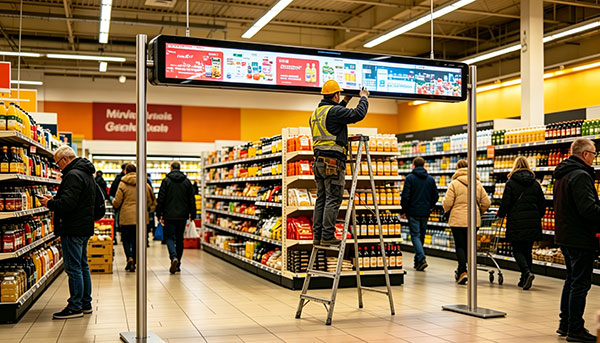
拉伸条形显示器通过将被动表面转换为主动通信层来解决这一差距。这些面板安装在货架边缘的视线高度,可以提供促销定价、产品故事、营养数据、库存信息和实时内容——所有这些都在一个不会破坏货架核心功能的外形内。
1.2为什么货架制造商是关键推动者
显示器供应商和零售商已尝试独立部署 拉伸条形面板 多年来,结果喜忧参半。根本问题在于机械:显示屏不是货架产品,螺栓安装解决方案会造成维护噩梦、美学不一致和结构责任问题。
最干净、最可扩展的部署发生在显示器从一开始就设计到机框系统中的时候——具有集成的电缆管理、标准化的安装接口和专门构建的结构支撑。这就是为什么领先的零售商越来越多地要求他们的货架系统供应商提供集成显示解决方案,而不是单独采购显示器。
市场驱动因素 | 一级杂货店、药店和百货零售商正在积极认证具有集成数字功能的新货架系统。没有可靠显示器的货架制造商有可能在2026-2027年的更新周期中失去首选供应商的地位。 |
1.3货架制造商的竞争格局
竞争格局正在迅速变化。已成功集成拉伸条显示器的早期货架制造商报告称:
• 与同类非数字货架系统相比,合同溢价为20-40%
• 由于专有内容管理集成,零售商粘性更高
• 来自显示器维护和内容服务的新的经常性收入来源
• 加速规范在新店建设和改造项目中获胜
将显示器集成视为事后想法的制造商——将显示器作为可选配件而不是工程系统组件提供——发现零售商更喜欢拥有更多交钥匙解决方案的竞争对手。
2.技术概述:是什么让条形显示器与众不同
2.1面板架构和纵横比
拉伸条形显示器 是LCD面板的一个特殊类别,其特征是超宽的纵横比。虽然消费者显示器通常使用16:9的比例,但拉伸条形面板的范围从3:1(例如1280×390)到8:1(例如1920×240)或更宽。所选的特定纵横比必须与目标货架系统中可用的物理货架边缘高度相对应。
宽高比 | 典型分辨率 | 面板高度 | 最佳应用 |
3:1 | 1280 × 390 | ~39毫米 | 开放式缆车货架 |
4:1 | 1280 × 320 / 1920 × 480 | 约32至48毫米 | 中档价格轨 |
5:1 | 1920 × 380 | 约38毫米 | 药房/专业零售 |
7:1 – 8:1 | 1920 × 240 / 1280 × 160 | ~24–28毫米 | 薄型高级货架 |
面板高度是货架集成中最受约束的单一尺寸。大多数零售货架系统的货架边缘高度在25毫米到55毫米之间。在评估任何其他规格之前,必须从精确测量可用的信封开始选择显示器。
2.2亮度和观看环境
零售环境带来了与标准商业标牌应用根本不同的重大显示挑战。杂货店和药店通常在800-1200lux的环境光下营业。有冷冻通道的超市可以有超过2000勒克斯的局部照明,直接照亮货架边缘的面板。
货架边缘应用的最低推荐亮度为700 cd/m²(nits)。对于有直接顶置照明或机箱照明的环境,强烈建议使用1000cd/m²。亮度规格过小是部署安装中图像质量差的最常见原因,也是在不更换面板的情况下最难修复的原因。
采购预警 | 报价低于700尼特用于货架边缘部署的面板的供应商要么针对不同的用例,要么不了解典型零售环境中的环境条件。每份报价都需要经过认证的亮度测试数据。 |
2.3封闭式货架系统的热管理
标准液晶面板设计用于露天环境。当集成到封闭式货架挤压件中时,特别是那些由粉末涂层钢或铝制成的挤压件,热条件会发生显著变化。面板工作温度额定值必须根据连续操作下货架挤压内的最坏温度进行验证。
货架集成设计的关键热考虑因素包括:
• 面板后表面和货架结构之间的最小间隙为5mm,用于对流气流
• 避免将电源线直接布线在面板背光区域后面
• 在冷藏区,确认面板的最低储存温度(通常为-20°C)与运输和安装条件相匹配
• 请求额定温度和额定温度以上+10°C的MTBF(平均故障间隔时间)数据,以模拟性能退化
2.4接口和连接标准
拉伸条形显示器具有一系列输入接口。对于机架集成,实际的选择几乎总是在HDMI和专有串行接口(RS-232/RS-485)之间。该选择对系统架构具有重大影响。
接口 | 优势 | 注意事项 |
HDMI/迷你HDMI | 通用兼容性、标准媒体播放器、易于内容集成 | 电缆体积大,机架导轨中的连接器耐用性,4K延迟开销 |
RS-232/RS-485 | 菊花链拓扑结构、低剖面布线、低功耗、长距离运行 | 需要专有驱动程序、内容丰富性有限、供应商锁定 |
USB-C/DP Alt模式 | 单电缆电源+数据,现代标准,紧凑型连接器 | 面板可用性有限,请仔细验证电源交付规格 |
以太网/PoE | 网络原生,远程管理,无专用媒体播放器 | 系统成本更高,需要达到货架级别的网络基础设施 |
3.集成工程:将显示器构建到货架系统中
3.1机械集成原理
显示面板和货架挤压之间的机械接口是大多数集成项目遇到第一个严重问题的地方。显示器制造商和货架制造商都是各自领域的专家;它们之间的接口需要明确的协同工程。
三种常用的机械集成方法:
方法A——专用显示轨道挤压
货架系统包括一个专门设计的铝挤压型材,该型材通过前部负载卡扣配合或免工具滑动安装来接受显示面板。这是最高质量的集成,提供干净的美学、可靠的保留和可维护性。它要求显示器和货架制造商之间进行密切的尺寸协调,建议用于部署500英尺以上货架的程序。
方法B——通用支架系统
中间支架组件旨在使显示面板适应现有的标准货架挤压(例如Hettich、Lozier、Madix)。这种方法可以在不重新设计挤压的情况下部署到现有的货架系统中,但通常会增加4-8mm的安装深度,并可能损害美观。它适用于改造项目和中型部署。
方法C——粘合剂或磁性安装
供应商经常提出基于磁带或磁性安装作为低成本选择。除临时或试点安装外,应避免使用。如果面板在公共环境中脱落,粘合安装会带来永久性的现场服务挑战、热膨胀故障和责任问题。
工程建议 | 在设计机框集成之前,始终向显示器供应商索取面板组件的3D STEP文件(包括PCB堆叠高度、连接器位置和电缆出口角度)。未提供尺寸文件的面板应被取消入围资格。 |
3.2电缆管理架构
在货架展示项目中,电缆管理一直被低估。一个3.6米(12英尺)的单层货架,显示器以600毫米的间隔安装,需要6个面板,每个面板至少有一根电源线和一根信号线。乘以货架级别的数量(通常为4-6)和商店中的夹具数量(100+),电缆管理成为主要的工程和安装成本驱动因素。
电缆管理设计的最佳实践:
• 通过货架立柱或背板中的集成通道布线电源和信号——切勿在购物者可见的货架组件上安装表面安装电缆夹
• 在可能的情况下,每个机框级别设计一个电缆分支,通过机框集成母线或信号分离器进行水平分布
• 指定支持免工具现场更换的连接器类型——涉及连接器维修的服务电话费用过高
• 在机架剖面的每个电缆入口和出口点包括应力释放
• 提供颜色编码的电缆标签规范,并要求在所有电缆组件上进行工厂预标签
3.3电源架构和负载计算
根据尺寸和亮度,每个面板的拉伸条形显示器的功耗在5W到18W之间。对于货架级电源设计,计算必须考虑峰值负载(所有面板在最大亮度下显示白色/黄色内容),而不是典型的工作负载。峰值负载时1.25×的保守倍数适用于电源尺寸。
标准机框显示器电源配置:
• 24V DC分布式电源,每个面板都有本地DC/DC调节——最常见、最干净的安装
• 用于网络连接显示器的48V PoE简化了基础设施,但需要管理交换机投资
• 12V DC适用于低功耗薄型面板——降低了线规要求,但限制了可用的面板选项
始终要求显示器供应商为电源组件提供IEC 62368-1或UL 60950-1认证文件,特别是在美国和欧盟市场的部署。
3.4内容管理系统集成
显示硬件的价值取决于驱动它的内容系统。货架制造商越来越需要提供或至少证明与零售商使用或计划使用的内容管理平台的兼容性。北美和欧洲零售业部署最广泛的平台包括:
• Pricer ESL和Displaydata用于价格标签相邻的应用程序
• 三星MagicINFO和LG SuperSign用于HDMI/网络内容
• 用于企业CMS环境的Scala和Four Winds Interactive
• 通过REST API实现定制零售ERP集成,实现动态定价覆盖
在评估显示器供应商时,要求提供一份软件兼容性矩阵,记录与主要CMS平台的测试集成。只提供硬件而不考虑软件兼容性的供应商可能会在下游创建昂贵的集成项目。
4.采购评估:选择合适的显示器制造商
4.1真正重要的八个标准
评估显示器供应商的货架制造商经常关注标题规格——分辨率、亮度、价格——而低估了最终决定项目成功的因素。以下八个标准代表了一个更完整的评估框架,按其对总项目风险的影响进行排名。
# | 标准 | 评估什么 |
1 | 产品寿命承诺 | 书面承诺至少5年的生产连续性;有文件记录的报废通知流程(至少提前12个月通知) |
2 | 尺寸稳定性 | 面板之间的尺寸变化<;0.5毫米;使用多个制造批次的生产样品进行验证 |
3 | 定制能力 | 能够调整挡板轮廓、连接器位置、安装孔图案和电缆出口角度,NRE不超过15000美元 |
4 | Certification Portfolio | CE, FCC, RoHS, REACH, and optionally UL/ETL for North American retail environments |
5 | Minimum Order Flexibility | MOQ ≤500 units for initial program development; path to lower MOQ for spare parts program |
6 | Lead Time Reliability | Published lead times with on-time delivery history (request 12-month OTD data); buffer stock availability |
7 | Technical Support Access | Dedicated FAE (Field Application Engineer) assignment; response SLA of <4 hours for production issues |
8 | Warranty and RMA Process | Minimum 2-year warranty; advance replacement available; documented failure rate data by model |
4.2 Red Flags in Supplier Evaluation
The following supplier behaviors are reliable indicators of downstream project risk. Any one of these should trigger deeper due diligence; multiple occurrences should lead to disqualification.
• Unable or unwilling to provide production samples within 4 weeks of inquiry
• Brightness or resolution specifications not backed by independent test reports
• No written product longevity commitment — verbal assurances are insufficient
• Quotations that specify a single-source panel from a tier-3 panel manufacturer with no backup
• Lack of familiarity with CE/FCC certification requirements for the target market
• CMS compatibility claims not supported by integration documentation or reference customers
• No prior experience with shelf or fixture integration (only standalone signage deployments)
DUE DILIGENCE TIP | Request the names of two shelf manufacturer reference customers who have deployed the proposed panel model in production volumes. A supplier with genuine shelf integration experience will be able to provide these without hesitation. |
4.3 Total Cost of Ownership Analysis
Panel unit cost is rarely the largest element of total program cost. A realistic TCO analysis for a shelf display program spanning 50 retail locations over 5 years must account for the following cost categories:
Cost Category | % of 5-Year TCO (Typical) | Key Driver |
Panel hardware (initial) | 28–35% | Unit price × total installed count |
System integration engineering | 12–18% | Complexity of shelf-display interface design |
Installation labor | 18–25% | Cable management complexity and tool requirements |
Content management system | 8–14% | CMS licensing and custom development |
Field service and replacement panels | 10–16% | Panel MTBF, connector reliability, service accessibility |
Spare parts program | 4–8% | Supplier MOQ for spares, shelf life of panels |
This analysis consistently shows that reducing installation labor and field service costs through better mechanical design yields a higher ROI than negotiating marginal savings on panel unit price. A panel that costs 10% more but reduces installation time by 30% and field service calls by 50% will be significantly cheaper over a 5-year program lifecycle.
5. Technical Specification Reference
5.1 Minimum Recommended Specifications for Retail Shelf Deployment
The following specifications represent minimum thresholds for production deployment in standard retail environments. Programs with specific environmental challenges (freezer aisles, outdoor-facing windows, food service) should consult with the display manufacturer for environment-specific guidance.
参数 | Minimum Specification for Retail Shelf Deployment |
Panel Brightness | 700 cd/m² (1,000 cd/m² recommended for high-ambient environments) |
对比度 | 800:1 minimum (1,200:1 preferred) |
Color Gamut | 72% NTSC (sRGB equivalent) minimum |
视角 | 160° horizontal / 120° vertical (H/V) |
工作温度 | 0°C to +50°C; storage -20°C to +60°C |
工作湿度 | 10% to 85% RH non-condensing |
Panel Life (MTBF) | ≥ 30,000 hours at rated brightness |
背光类型 | LED only (CCFL panels are not acceptable) |
输入接口 | HDMI 1.4 or higher; RS-232 for serial-controlled deployments |
电源输入 | DC 12V or 24V ±10%; ripple <200 mV |
Power Consumption | < 15W per panel (30" class); < 8W per panel (under 18") |
Bezel Tolerance | ±0.3 mm on height-critical dimensions |
Certifications | CE + RoHS for EU; FCC Class B + UL/ETL for North America |
保修 | 24 months minimum from date of shipment |
5.2 Standard Panel Size Reference
The following panel sizes represent the most commonly deployed formats in retail shelf environments globally. Availability varies by supplier; confirm production status before designing to a specific size.
Diagonal Size | 分辨率 | Active Width | Active Height | Typical Application |
8.8" | 1920 × 480 | 218 mm | 56 mm | Standard gondola shelving |
11.9" | 1920 × 480 | 295 mm | 74 mm | Supermarket aisle end-cap |
14.9" | 1920 × 360 | 369 mm | 70 mm | Pharmacy / HBC shelving |
19.3" | 1920 × 360 | 478 mm | 90 mm | Wide-shelf general merchandise |
23.1" | 1920 × 360 | 573 mm | 108 mm | Refrigerated case shelf front |
28.6" | 2560 × 360 | 710 mm | 100 mm | Premium / flagship store shelving |
6. Implementation Roadmap for Shelf Manufacturers
6.1 Program Development Phases
Successful shelf display integration programs follow a structured development process. Shelf manufacturers who attempt to compress or skip phases consistently encounter costly redesigns and deployment delays. The following timeline assumes a standard program with a new retail customer.
Phase | Duration | Key Activities & Milestones |
1 — Discovery | 2–4 weeks | Shelf dimension survey; retailer requirement brief; CMS platform identification; display supplier RFQ release |
2 — Concept Design | 4–6 weeks | Panel selection and 3D STEP integration; cable routing concept; power architecture schematic; supplier evaluation and down-select |
3 — Prototype | 6–10 weeks | First article panels from supplier; prototype shelf extrusion with display; cable management mockup; thermal test at rated conditions |
4 — Pilot | 8–12 weeks | 25–50 shelf units installed in 1–2 live retail locations; content management integration test; staff training validation; snag list resolution |
5 — Production Ramp | Ongoing | Full production tooling; supplier volume scheduling; spare parts program establishment; field service documentation |
6.2 Managing the Supplier Relationship
The relationship between a shelf manufacturer and a display supplier is fundamentally different from a standard component procurement relationship. Display suppliers must function as engineering partners, not just vendors. Setting up the relationship correctly from the beginning prevents the most common and costly failure modes.
Recommended structural elements of a display supplier partnership:
• Joint product development agreement with IP ownership terms explicitly defined
• Quarterly business reviews covering delivery performance, quality data, and roadmap alignment
• Assigned FAE with direct access during prototype and pilot phases
• Written EOL notification obligation of not less than 12 months
• Buffer stock agreement — supplier maintains 4–8 weeks of inventory for the program
• Agreed failure rate targets with remediation triggers and financial consequences
6.3 Field Service and Maintenance Design
Display panels will fail in the field. The rate and pattern of failures is predictable and must be planned for in the shelf system design. Panels that require tool access or shelf section removal for replacement will generate disproportionate service costs and retailer dissatisfaction.
Design for serviceability principles:
• Front-access panel removal — the failed panel should be replaceable from the shopper aisle side without moving product or dismounting the shelf
• Snap-fit or quarter-turn connector retention — avoid fastener-based panel retention in high-service programs
• Unique panel orientation keying — prevents incorrect reinstallation in the field
• LED indicator for power-on status visible from front without panel removal for rapid fault isolation
SERVICE COST BENCHMARK | Field service calls to replace a display panel range from $85 to $250 per event depending on store location and labor agreement. A shelf design that reduces mean replacement time from 25 minutes to 8 minutes reduces per-event cost by approximately 55% — far exceeding the cost of any mechanical design optimization. |
7. Conclusion: Building a Sustainable Digital Shelf Capability
Stretched bar displays represent a generational opportunity for shelf system manufacturers. The retailers who will dominate the next decade of physical commerce are investing heavily in making every shelf an active communication and commerce platform. The shelf manufacturers who earn their business will be those who can deliver integrated display solutions that are engineered to last, easy to service, and genuinely differentiated from what a retailer could assemble independently.
The path to that capability is not simple. It requires technical depth in display engineering, mechanical design discipline, supply chain partnerships that go beyond transactional procurement, and a commitment to field service quality that spans years. But the competitive moat it creates — once established — is substantial and durable.
The key principles to carry forward from this guide:
• Start with the shelf envelope — display selection must follow dimensional constraints, not precede them
• Specify brightness correctly — 700 nits minimum; 1,000 nits for most grocery environments
• Design mechanical integration as a co-engineering project with the display supplier
• Build cable management into the shelf architecture, not around it
• Evaluate suppliers on longevity commitment, support quality, and integration experience — not on unit price alone
• Plan the field service model before the first unit ships, not after the first failure
Manufacturers who approach digital shelf integration with the same engineering rigor they apply to their structural shelf systems will build programs that succeed at scale — and customers who recognize that quality will remain loyal partners for program lifetimes measured in years, not purchase orders.
Ready to Start Your Shelf Display Program?
Contact our shelf integration engineering team to discuss your specific program requirements,
request production samples, or arrange a technical consultation.
www.hitulcd.com | chenhua@hitulcd.com