瀚图佳视
条形显示器事业部
技术白皮书
室内乘客信息系统中的条形液晶显示器
部署架构、性能工程和;市场差异化
文件编号。 | 惠普-2026-001 |
版本 | V2.1 |
签发日期 | 2026 |
保密性 | 客户端共享版 |
部门 | 产品技术中心 |
适用市场 | 轨道交通/机场/高铁/商业 |
执行摘要
城市轨道交通、国际机场、高铁枢纽和大型商业综合体的全球扩张对乘客信息系统(PIS)提出了前所未有的硬件要求。传统的16:9和4:3 LCD面板——专为桌面计算和消费者娱乐而设计——在结构上与公共交通基础设施固有的细长安装空间不匹配:门楣、站台柱、头顶行李架和走廊封檐。
瀚图佳视条形LCD显示器在硬件层面解决了这种不匹配问题。瀚图佳视产品具有7:1至32:1的原生纵横比、专有的信号处理架构和工业级的环境弹性,为室内PIS环境提供了物理上一致的显示解决方案。本白皮书对瀚图佳视核心技术优势、六个室内PIS子类别的典型部署场景、与主流显示器替代品的十四维竞争基准矩阵、完整的系统集成规范和经过验证的现场案例研究进行了严格分析,为系统集成商、采购工程师和项目规划者提供了做出自信采购决策所需的证据基础。
核心价值主张 原生形状因子匹配——无遮蔽,无拼接;与集管、柱和封檐带通道匹配的几何图形 高环境亮度——700–1500 cd/m²,在室内高架照明下保持易读性 工业可靠性——MTBF≥50000小时;设计用于7×24不间断运行 多协议集成——跨所有主要PIS中间件栈的本地RS485/UDP/HTTP/MQTT支持 全生命周期TCO优势——低功耗设计和模块化可维护性将运营成本降低30%+ |
第一章市场背景与;行业痛点
1.1乘客信息系统中显示硬件的演变
PIS显示硬件已经经历了三代人的转变:机械分体式盖板、LED点阵面板和液晶显示器。自2010年代中期以来,LCD技术的卓越色彩保真度、动态多媒体功能和较低的生命周期维护成本使其成为新建和改造项目的主要规格。然而,消费电子行业标准化的16:9和4:3宽高比从未针对公共交通基础设施的空间限制进行过优化。
随着主要城市地铁网络的日客流量超过100万人次,国际机场每年处理数千万旅客,乘客对实时信息准确性和可见性的期望急剧上升。与此同时,交通建筑师和室内设计师越来越要求显示硬件与车站美学无缝结合,这是一个传统的标准;屏幕堆叠”;方法不一致。
1.2 PIS环境中标准矩形屏幕的结构缺陷
根据国际上200多个轨道交通车站的瀚图佳视工程调查和累积的项目数据,五个系统性痛点反复出现:
▪ 空间效率低:当标准16:9显示器安装在门楣上时,只有不到40%的面板面积携带有效信息;其余的则充满了背景图形或死黑色,浪费了昂贵的显示空间,降低了乘客的视觉捕捉率。
▪ 拼接接缝处的易读性中断:多屏幕拼接引入了物理间隙,中断了滚动时间表和运行文本,在乘客需要连续信息流的时刻造成可读性中断。
▪ 安装复杂性高:用定制支架、遮蔽框架和电缆导管改装的标准面板使每个节点的安装劳动力增加了2-4x,总安装成本也相应增加。
▪ 电源冗余:标准面板上的全背光驱动,其有效显示面积仅占面板表面积的一小部分,从而产生可避免的功耗;在一个大型终端上,这种过载可能会累积到数十千瓦。
▪ 延长维护停机时间:密闭空间中的大型标准显示器需要延长每次服务干预的轨道访问或平台排除窗口,这在高频运输环境中是一项关键的运营成本。
第二章瀚图佳视条形显示器产品架构
2.1产品定义和;外形规格
A. 拉伸条液晶显示器被定义为具有4:1或更大纵横比的工业级液晶面板。瀚图佳视产品线涵盖了从7:1到32:1的整个商业范围。与消费者面板伸长方法不同,瀚图佳视采用专用的工业母玻璃切割工艺,并配有定制背光组件,确保整个面板区域的亮度均匀性(均匀性≥85%)和色温一致性(ΔE<;3),始终符合商业显示标准。
型号系列 | 宽高比 | 典型分辨率 | 物理尺寸(英寸) | 初级PIS应用 |
SB-700系列 | 7:1 | 1680×240 | 29"–35" | 小门头显示器 |
SB-1000系列 | 10:1 | 1920×192 / 2560×256 | 32"–40" | 站台列车信息 |
SB-1600系列 | 16:1 | 1920×120 / 3840×240 | 40"–55" | 走廊寻路 |
SB-2300系列 | 23:1 | 2560×112 / 4096×178 | 55"–72" | 广场广告和;信息 |
SB-3200系列 | 32:1 | 3840×120 / 5120×160 | 72"–100" | 大型候车厅招牌 |
2.2核心技术规格
2.2.1光学性能
HITULCD光学参数专门针对室内公共空间的复杂环境光条件进行校准:
光学参数 | 标准(室内标准) | 增强型(室内增强型) |
亮度 | 700 cd/m² | 1000 cd/m² |
对比度 | ≥ 1200:1 | ≥ 1500:1 |
视角(H/V) | 178° / 178° | 178° / 178° |
色域 | 72%NTSC | 85%NTSC(DCI-P3 90%) |
背光寿命 | ≥50000小时 | ≥60000小时 |
亮度均匀性 | ≥ 82% | ≥ 88% |
色温 | 6500K±300K | 6500K±200K(可调) |
2.2.2信号与;接口规范
接口类型 | 规格 | 备注 |
视频输入 | HDMI 2.0/DisplayPort 1.2 | 支持4K@60Hz信号输入 |
网络接口 | RJ45 100M/1000M以太网 | UDP/TCP/HTTP内容推送 |
串行接口 | RS232/RS485(可选) | 传统PIS控制系统兼容性 |
无线(可选) | Wi-Fi 802.11ac/4G LTE | 无电缆改造部署 |
内部存储 | eMMC 16GB/32GB(可选) | 本地内容缓存和;离线播放 |
控制协议 | httprest/mqt/UDP | 与主要PIS中间件平台兼容 |
2.2.3环境与;可靠性规范
环境参数 | 规格 | 测试标准 |
工作温度 | 0°C~+50°C | IEC 60068-2 |
储存温度 | -20°C~+60°C | IEC 60068-2 |
相对湿度 | 10%~90%相对湿度(非冷凝) | IEC 60068-2-78 |
防护等级 | IP40(标准)/IP54(可选) | IEC 60529 |
抗振性 | 10~200Hz,0.5g | IEC 60068-2-6 |
平均故障间隔时间 | ≥50000小时 | Telcordia SR-332 |
认证 | CE/FCC/RoHS/CB | — |
第3章室内PIS部署场景
3.1场景概述
室内PIS显示要求与路边、户外广告和一般商业应用有着根本的不同。封闭运输空间内的乘客流动路径具有高度的可预测性;信息需求具有强烈的时间顺序性(列车到达/出发时间、换乘寻路、紧急疏散指示);安装位置总是受到现有建筑结构的限制。HITULCD拉伸条形显示器的物理几何形状与这些要求内在一致。以下部分提供了六个典型室内PIS子场景的工程级分析。
3.2站台门顶盖显示系统
3.2.1场景特征
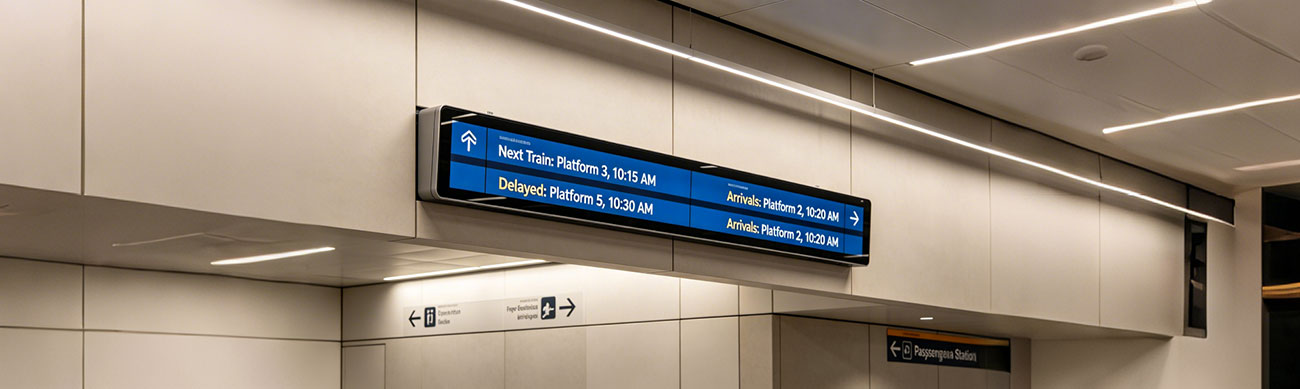
站台屏蔽门(PSD)或安全栅上方的门楣区是候车乘客最自然的视觉停留点,也是车站信息密度最高的PIS位置。收割台高度通常在150mm至300mm之间;宽度对应于门板尺寸,标准为1200mm-2000mm。
3.2.2 HITULCD解决方案
▪ 推荐型号:SB-1000-32/SB-1000-40(宽高比10:1,分辨率1920×192)
▪ 安装方式:正面接入嵌入式安装,面板表面与顶盖表面共面;符合UTO(无人值守列车运行)维护访问标准
▪ 内容能力:在四个独立的内容区域同时显示列车目的地、下一次出发时间、当前停站位置和紧急文本警报
▪ 同步精度:跨所有平台屏幕的UDP组播帧同步实现≤16ms的屏幕间延迟;滚动文本在所有单元之间视觉上无缝衔接
▪ EMC屏蔽:全金属后壳;EMC性能符合EN 50121-4铁路应用电磁兼容性标准
3.3大厅寻路显示系统
3.3.1场景特征
车站大厅是入口、出口和换乘的主要乘客分布节点。立柱、检票口顶部和高架通道面板都需要导向显示硬件。这种情况需要宽的观看距离容差(1米-8米)、高的安装高度灵活性和亚秒级的内容切换延迟。
3.3.2 HITULCD解决方案
▪ 立柱包覆:SB-700系列(7:1)安装在所有四个立柱面上,提供360°信息覆盖,没有视觉盲区
▪ 通道开销:SB-1600系列(16:1)跨越整个通道宽度,提供统一的出口/转移方向引导
▪ 检票口顶部:SB-700-29(29英寸)嵌入检票口顶部框架,显示售票状态和拥堵程度指示器
▪ 基于区域的内容:单个显示主体最多可同时支持三个独立管理的内容区域
3.4车载列车车厢部署
3.4.1场景特征
下一代地铁和城际轨道车辆规范要求车内动态路线图和多媒体内容系统。可用的安装空间受到严重限制:门楣梁上方高度为80mm-200mm;行李架下方的间隙通常为100mm-180mm。这两个位置都将屏幕放置在距离就座乘客1.0-1.5米的范围内,这使得像素密度甚至亮度对可读性至关重要。
3.4.2 HITULCD解决方案
▪ 门楣梁上方:SB-1000-32,总深度<;25mm;满足车辆限界要求
▪ 行李架下方:SB-700-29低功耗变体(≤8W);接受DC 24V/36V车辆电源输入
▪ 动态路线图引擎:车载矢量路线图渲染器接收实时ATS(列车自动监控)位置信号,并动态突出显示当前车站
▪ 多语言自动切换:支持8种语言配置文件(英语、普通话、日语、韩语等),可自动切换国际枢纽部署
▪ 机车车辆认证:符合EN 45545-2铁路车辆防火标准;阻燃等级HL2
3.5机场登机口信息显示系统
3.5.1场景特征
机场登机口PIS要求是高度动态的:一个登机口每天可能服务数十个不同的航班,因此需要在航班之间进行二级内容转换。系统必须与航空公司标准信息格式(兼容IATA CUTE/CUSS)接口。200mm至400mm的门平台顶盖高度代表了拉伸条形显示器的理想原生安装位置,消除了所有遮蔽要求。
3.5.2 HITULCD解决方案
▪ 推荐型号:SB-1000-40/SB-1600-50(1920×192@40英寸;1920×120@50英寸)
▪ FIDS模板:预先配置的航班信息显示系统标准模板,与DCS(离港控制系统)API集成
▪ 自适应亮度:环境光传感器根据终端照明条件自动调整背光强度;节能高达35%
▪ Dual-Hot-Standby: Primary/backup media player hot-failover with recovery time ≤3 seconds; meets airport critical-information-system 99.95% availability requirement
3.6 Commercial Complex Information & Wayfinding Systems
3.6.1 Scenario Characteristics
Large-scale commercial complexes (shopping centers, exhibition halls, sports arenas) require indoor digital signage that serves dual functions: operational wayfinding and brand marketing. Installation locations include elevator lobby fascias, escalator side panels, and corridor ceiling soffits. Compared to transport hubs, commercial environments place greater emphasis on color fidelity and creative content compatibility.
3.6.2 HITULCD Solution
▪ Recommended Models: SB-1600 Enhanced (85% NTSC wide color gamut) to satisfy brand visual identity specifications
▪ CMS Integration: Standard SMIL / HTML5 content format; compatible with major digital signage CMS platforms (Scala, Signagelive, BrightSign)
▪ Split-Screen Advertising: 1–4 independent content zones support simultaneous wayfinding and advertising monetization within a single display body
▪ Interactive Extension: Optional PCAP multi-touch overlay supports interactive wayfinding kiosk functionality
3.7 High-Speed Rail Terminal Deployments
3.7.1 Scenario Characteristics
High-speed rail passenger terminals present three architecturally distinct PIS deployment tiers: the waiting hall, the ticket-gate array, and platform canopy structures. Large passenger volumes and relatively extended dwell times demand comprehensive information completeness, while systems must maintain live data synchronization with national rail scheduling platforms.
3.7.2 HITULCD Solution
▪ Waiting Hall Ceiling Beams: SB-2300-65 (23:1, 2560×112) displays hall-wide seating zone guidance across the full beam span
▪ Ticket Gate Array: SB-700-32 embedded in gate top frame shows gate status and waiting area directional indicators
▪ Platform Canopy Columns: SB-1000-40 IP54-rated version; withstands elevated humidity and moisture ingress in semi-exposed platform environments
▪ TDCS Interface: Standard OPC-UA interface connects to Railway Train Dispatching Computer Systems for real-time train movement information push
Chapter 4 Competitive Benchmarking: HITULCD vs. Market Alternatives
4.1 Competitive Landscape Definition
This chapter presents an objective fourteen-dimension comparative analysis of HITULCD stretched bar displays against four mainstream market alternatives: standard commercial LCD monitors, LED dot-matrix/COB panels, e-paper (electronic ink) displays, and generic-brand bar displays (represented by commonly available industrial portrait/bar screens). Evaluation dimensions span form-factor fit, display performance, system integration, reliability, and total cost of ownership.
4.2 Comprehensive Performance Benchmarking Matrix
Evaluation Dimension | HITULCD Stretched Bar | Standard Commercial LCD | LED Dot-Matrix / COB | E-Paper Display | Generic-Brand Bar Screen |
Aspect Ratio Range | 7:1 ~ 32:1 (native) | 16:9 / 4:3 (fixed) | Customizable (high cost) | 1:1 ~ 4:1 typical | 4:1 ~ 16:1 |
Indoor Brightness | 700–1500 cd/m² | 250–400 cd/m² | 2000+ cd/m² (high power) | Reflective (no backlight) | 400–800 cd/m² |
Color Fidelity | 72–85% NTSC | 72%NTSC | Limited by pixel pitch | 16 grayscale levels | 72%NTSC |
Video / Dynamic Content | 60Hz full video support | 60Hz full video support | Driver-card dependent | Not supported | 60Hz video support |
Resolution (PPI) | High (≥60 PPI) | High (≥80 PPI) | Low (pitch ≥1.2mm) | Medium (200 DPI) | Medium (40–60 PPI) |
Installation Space Fit | Native fit to fascia geometry | Requires custom masking brackets | Requires custom framework | Compatible, limited content | Basic compatibility |
Typical Power Draw | 8–35W (size-dependent) | 30–80W (size-dependent) | 50–200W (pixel-count dependent) | ≤1W (brief at refresh) | 15–50W |
PIS Protocol Support | RS485/UDP/MQTT native | Requires external media player | Proprietary controller protocols | Limited (vendor-specific) | Partial support |
平均故障间隔时间 | ≥50,000 hours | 30,000–40,000 hours | ≥100,000 hours (LED die) | ≥10 years (static) | 30000-50000小时 |
Operating Temp. Range | 0~50°C | 0~40°C (consumer grade) | -20~60°C | -20~70°C | 0~50°C |
Rail Transit Certification | EN 50121-4, EN 45545-2 | Typically absent | Partial | Typically absent | Rarely held |
Serviceability | Front-access, modular | Typically rear-access only | LED module swap-out | Near-zero maintenance | Vendor-dependent |
Unit Acquisition Cost | Mid-range (best TCO) | Low (high total cost) | 高 | Low–Mid | Low–Mid |
Technical Support Depth | Full-stack + custom dev | 有限的 | Hardware-only | 有限的 | 有限的 |
4.3 Key Differentiators: In-Depth Analysis
4.3.1 Native Form-Factor Integrity: Zero-Compromise Physical Fit
This is the most fundamental differentiator between HITULCD products and standard commercial LCD panels. Fitting a standard 16:9 display into a 200mm door header necessitates masking or letterboxing that reduces effective display area by more than 60%, while the added masking frame increases structural depth and degrades architectural finish quality. HITULCD panels are dimensioned from first principles for elongated spaces: resolutions such as 1920×192 concentrate every pixel resource within the active display area. There is no physical space waste.
4.3.2 HITULCD vs. LED Dot-Matrix Panels: Fundamental Distinctions
LED dot-matrix and small-pitch COB panels have clear advantages in outdoor large-format and ultra-high-brightness applications, but carry inherent limitations in indoor close-proximity PIS environments. Pixel pitches of 1.2mm or greater produce visible grain at the 0.5–1.5m viewing distances typical of in-carriage installations, materially impairing text legibility. RGB direct-emission point sources generate significant glare and light pollution in relatively dim indoor environments. Control card communication protocols are typically proprietary, imposing high PIS integration overhead. HITULCD's LCD edge-lit diffusion technology produces a uniform planar light source with demonstrably superior text readability at 0.5–3.0m viewing distances.
4.3.3 HITULCD vs. Generic-Brand Bar Screens: The Depth Differential
Several general-purpose industrial display manufacturers offer bar-format products, but HITULCD's differentiation operates at three distinct levels. First, industry-specific certification: HITULCD products carry full EN 50121-4 Railway Applications EMC certification; generic bar screens typically hold only CE/FCC consumer-grade approvals. Second, integration capability: HITULCD provides a complete SDK with PIS protocol stacks and reference architectures, substantially reducing systems-integrator secondary development effort. Third, engineering support depth: HITULCD field engineering teams carry full-stack competency from display hardware through signal processing to content management platforms, enabling turnkey project delivery — a capability absent from hardware-only generic screen suppliers.
4.4 Five-Year Total Cost of Ownership (TCO) Analysis
Acquisition price is not a sufficient basis for display hardware evaluation. Based on HITULCD project data from a representative mid-size metro station (8 platforms, 40 display nodes), the following 5-year TCO comparison illustrates the full economic picture:
Cost Component | Standard LCD Tiled Solution | HITULCD Stretched Bar Solution | Variance |
Hardware Acquisition | ¥ 480,000 | ¥ 360,000 | Save 25% |
Custom Brackets & Installation | ¥ 220,000 | ¥ 80,000 | Save 64% |
Systems Integration & Development | ¥ 150,000 | ¥ 60,000 | Save 60% |
5-Year Electricity (CNY 0.8/kWh) | ¥ 126,000 | ¥ 52,000 | Save 59% |
5-Year Maintenance & Replacement | ¥ 95,000 | ¥ 30,000 | Save 68% |
Total 5-Year TCO | ¥ 1,071,000 | ¥ 582,000 | Total saving 46% |
Chapter 5 System Integration Technical Specifications
5.1 Network Architecture & Content Distribution
HITULCD indoor PIS solutions support three network topology modes, selectable by station scale and existing infrastructure:
▪ Centralized Mode: All display endpoints connect via Ethernet to a central content management server. Recommended for new-build projects with well-structured station control room networking.
▪ Distributed Mode: Zone controllers deployed per display area distribute content downstream via UDP multicast. Suited to large hubs or bandwidth-constrained network environments.
▪ Hybrid Mode: Critical information (emergency evacuation instructions) is hardcast via RS485 bus for guaranteed delivery; non-critical content distributed via IP network. Satisfies Railway Safety Integrity Level SIL2 requirements for critical information dissemination.
5.2 Content Format & Protocol Specifications
Protocol / Format | Function | 备注 |
MQTT v3.1.1 / v5.0 | Real-time train information push | QoS 1/2; TLS encryption supported |
HTTP REST API | Content management & status query | OpenAPI 3.0 documentation included with SDK |
UDP Multicast | Multi-screen frame synchronization | Inter-screen sync precision ≤16ms |
RS485 / Modbus RTU | Emergency broadcast & status monitoring | Up to 128 devices per bus |
HTML5 / CSS3 | Dynamic content templates | Canvas / WebGL hardware acceleration supported |
XML (SIRI / NeTEx) | Public transport information standard format | Compliant with EU PIS interoperability standards |
5.3 Installation Engineering Requirements
▪ Conduit Pre-installation: Specify Ø25mm conduit pre-installation during civil works phase; route dedicated power cable (≥2.5mm²) and Cat6A data cable
▪ Earthing: Display metal enclosures must be reliably earthed; earth resistance ≤4Ω to prevent electrostatic accumulation and EMI coupling
▪ Thermal Clearance: Recessed-mount installations must provide ≥10mm thermal clearance on all four panel edges; top-surface ventilation path must remain unobstructed
▪ Front-Access Maintenance Space: Front-access models require ≥300mm clear space in front of the panel face post-installation (per IEC 61082 maintenance access requirements)
▪ Anti-Vibration Mounting: On-board rolling stock applications use anti-vibration rubber isolation mounts; isolation efficiency ≥70% in the 5–50Hz frequency band
5.4 Power Design Specifications
▪ Mains Input: AC 100–240V, 50/60Hz; wide-range switching power supply with surge protection device (SPD) on input
▪ UPS Integration: Critical PIS display nodes should be connected to offline-mode UPS with switching time ≤20ms; minimum 30-minute runtime post-mains-loss
▪ Voltage Drop: In centralized DC distribution configurations, end-of-run voltage drop must not exceed 5% of rated supply; cable cross-section must be increased for runs exceeding 50m
▪ Residual Current Protection: Each supply circuit fitted with 30mA RCD (Residual Current Device) in compliance with IEC 60364-4-41
Chapter 6 Field Deployment Case Studies
6.1 Case Study A — Urban Metro Network-Wide PIS Upgrade
Project Scale: 12 lines, 280 stations, approximately 14,000 display endpoints
Challenge: The metro network had been built over a 15-year span, resulting in three generations of non-uniform PIS communication protocols (RS485, UDP, and HTTP coexisting) and three distinct door-header dimensional standards across different line construction periods. The replacement solution was required to maintain full backward compatibility with all legacy control systems.
Solution: HITULCD engineered a multi-protocol adaptive media player with an embedded protocol translation layer capable of auto-detecting the upstream control system type and dynamically switching communication mode. Three model variants (SB-700-29, SB-1000-32, SB-1000-40) were selected to achieve 100% dimensional coverage across all header size standards. The project was executed in three phases; single-phase implementation duration was reduced by 40% compared to comparable prior projects, primarily attributable to HITULCD's front-access design substantially reducing the frequency of track-access window applications.
Outcome: Post-commissioning, passenger information satisfaction scores increased by 22%; device fault rates fell to one-third of the previous LCD solution; annual electricity savings of approximately CNY 1.8M were realized.
6.2 Case Study B — International Airport Terminal T3 Renovation
Project Scale: 62 gates, 310 拉伸条显示 units deployed
Challenge: Terminal T3 serves as the primary international-route hub, requiring renovation to be completed in batches without service disruption. Display content was required to interface in real time with two airline DCS platforms (SITA and Amadeus) simultaneously.
Solution: HITULCD specified the SB-1000-40 Enhanced variant (1000 cd/m²) to address the terminal's high-ambient-illuminance environment. A dual-DCS adaptation layer was developed on the content platform side enabling unified parsing of both SITA and Amadeus data sources. All units were configured with primary/backup media player hot-standby failover at ≤3s recovery time, meeting the airport's 99.95% availability requirement for critical information infrastructure.
Outcome: The renovation was awarded the local Civil Aviation Authority Annual Smart Airport Innovation Award. Passenger gate information misread rates fell to one-fifth of those recorded under the previous LED dot-matrix installation.
Chapter 7 Service Architecture & Quality Assurance
7.1 Product Quality Management System
HITULCD manufacturing facilities are certified to ISO 9001:2015 Quality Management System and ISO 14001:2015 Environmental Management System standards. Panel production is executed in Class 1,000 cleanroom conditions. Every outgoing panel undergoes 72-hour full-brightness burn-in screening to eliminate early-life failures, ensuring delivered product DPPM (Defective Parts Per Million) of ≤50.
7.2 Global After-Sales Service Framework
▪ Standard Warranty: 3-year full-unit warranty; 5-year warranty on critical components (panel + backlight module)
▪ Response Times: 4-hour on-site response in primary domestic cities; 24-hour nationally; 48-hour internationally
▪ Spare Parts Commitment: Rolling 3-year spare parts inventory maintained for all current-production models; 10-year backward-compatible spare parts supply commitment for discontinued models
▪ Remote Operations: HITULCD Cloud Monitor platform provides 7×24 device health monitoring, predictive maintenance alerting, and remote firmware update
▪ Technical Training: Factory-certified engineer training program (HITULCD Certified Engineer, HCE) covering hardware installation, systems integration, and content management modules
7.3 Custom Engineering Capability
The HITULCD Product Technology Center offers custom engineering services extending beyond the standard product catalogue, encompassing panel dimension customization, resolution customization, interface configuration customization, enclosure material and finish customization, and bespoke protocol adaptation development for specific PIS platforms. Customization projects are executed under a joint development model with HITULCD engineers embedded on-site during system integration and commissioning. Minimum custom batch size is 100 units; lead times are typically 1.5–2.0x standard product lead time.
Chapter 8 Conclusion & Technology Roadmap
Stretched bar LCD displays are not simply elongated versions of standard panels. They represent a purpose-engineered display category, designed from first principles to address the information display requirements of public transport infrastructure. Through sustained deep engagement with rail transit, airport, and high-speed rail indoor PIS environments, HITULCD has developed durable technical differentiation spanning chip-level signal processing through system-level integration architecture, backed by a complete industry certification portfolio and a global service network.
Looking ahead, HITULCD will continue to invest in four technology directions: AI-driven adaptive brightness and content scheduling algorithms; Mini-LED backlight technology transfer to stretched bar form factors (extending HDR contrast ratio performance); edge-computing and display co-integration architectures (compressing content push latency to the millisecond range); and accessibility-enhanced feature sets compliant with universal design standards (synchronized audio announcement, tactile feedback integration).
HITULCD welcomes systems integrators, procurement engineers, and research institutions to engage with us in building long-term technology partnerships. Together, we can continue to advance the state of the art in passenger information system display technology.
Contact HITULCD Technical Enquiries: chenyun@hitulcd.com Sales Support: chenhua@hitulcd.com Engineering Hotline: +86 18682328732 (Weekdays 08:30–18:00 CST) Corporate Website: www.hitulcd.com Documentation & SDK Portal: www.hitulcd.com (API docs, CAD drawings, integration guides) |
This document is protected by copyright law. All rights reserved by HITULCD. No part of this publication may be reproduced, distributed, or used for commercial purposes without prior written authorization.
© 2026 HITULCD Stretched Bar Display Division. All Rights Reserved.