技术白皮书
零售数字标牌系列
拉伸条显示技术
现代零售货架边缘应用
动态产品沟通、Planogram智能和购物者参与
文档版本 2.4 | 2026年5月 | 分类 B2B技术参考 | 目标受众 零售技术买家 |

执行摘要
实体货架长期以来一直是零售商业的最后战场。在消费者到达商店时已经在网上比较了几十种产品的时代,货架边缘时刻必须做的不仅仅是显示价格——它必须提供信息、说服和转化。本白皮书对部署在杂货店、药店、消费电子产品和专业零售货架边缘环境中的拉伸条显示(SBD)技术进行了全面的技术和操作分析。
基于在欧洲、北美和亚太地区安装的20多万个货架边缘显示节点的实际部署经验,我们记录了拉伸条形状因素背后的工程原理,解决了零售运营商最常遇到的集成挑战,并量化了领先零售连锁店取得的商业成果。
关键发现 在货架边缘部署拉伸条形显示器的零售商报告称,类别转化率平均提高了23%,促销SKU的降价频率降低了31%,与价格透明度和产品信息可用性相关的购物者满意度得分也有了显著提高。当显示硬件、内容管理和货架图数据正确集成时,这些结果可以在各种格式类型之间再现。 |
本文档面向零售技术决策者、品类经理、门店运营总监以及支持他们的解决方案架构师和系统集成商。提供技术规范以实现准确的RFP范围界定和供应商比较。根据客户保密协议,案例研究数据已匿名化。
1.拉伸条形显示器:形状因素和技术原理
1.1定义拉伸条显示
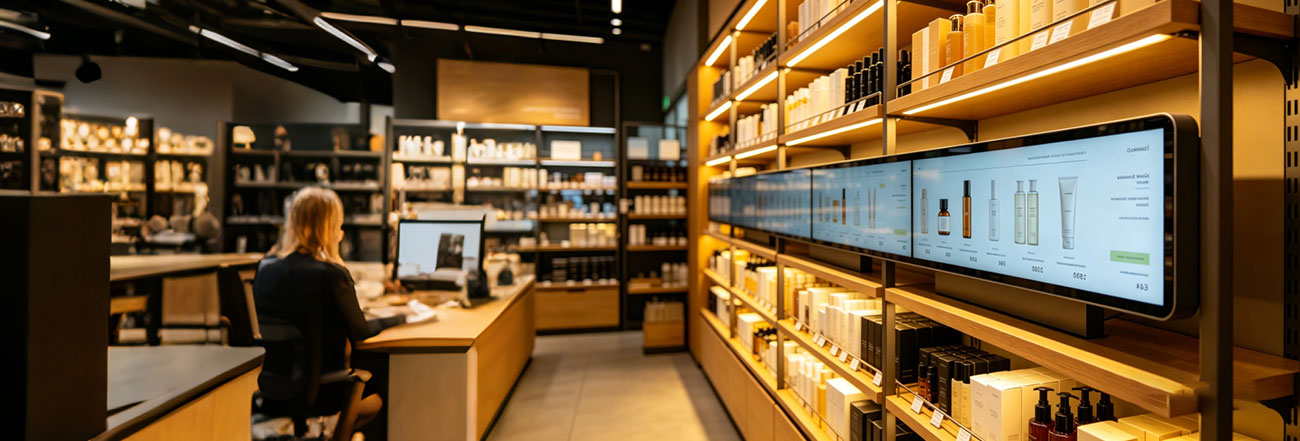
A. 拉伸条显示 (SBD) --在工业文献中也称为货架边缘显示器、条形LCD或超宽带显示器,是一种具有极端纵横比的液晶显示面板,通常在 7:1至32:1 (宽到高),以80毫米到220毫米的紧凑垂直高度制造。物理形状因子的设计旨在占据零售敞车货架边缘的精确占地面积,同时最大限度地提高水平信息带宽。
拉伸条形显示器的LCD矩阵与传统的矩形面板共享其核心电光技术:采用TN、IPS或VA面板技术的背光TFT-LCD基板。SBD的区别在于后制造工艺,通过该工艺将玻璃基板激光切割成细长的几何形状,并结合定制的时序控制器(TCON)映射,在非标准纵横比上重新分配像素阵列。这不是缝合的多面板组件——高级SBD是单基板、单控制器解决方案,可在整个显示屏表面提供无缝内容。
1.2可用纵横比和货架尺寸
零售货架环境施加了不可协商的尺寸限制。标准的欧洲缆车货架采用33毫米的间距系统;北美货架通常使用1英寸(25.4毫米)的间距。拉伸条形显示器的货架长度与这些标准间距倍数相对应:
参数 | 规格/值 |
常见SBD长度 | 500毫米、700毫米、1000毫米、1200毫米、1400毫米、2000毫米 |
面板高度选项 | 80毫米、120毫米、180毫米、220毫米 |
本地决议 | 1920×240, 1920×360, 2880×360, 3840×480, 5760×540 |
面板技术 | IPS(初级)、TN(成本敏感型)、VA(高对比度环境) |
视角(IPS) | 178°H/178°V(CR>10:1) |
典型亮度 | 700–1500 cd/m²(货架环境变量高达2500 cd/m²) |
对比度 | 1000:1(典型);3000:1(增强型VA变体) |
响应时间 | ≤8ms(灰色到灰色) |
平均故障间隔时间 | 在25°C环境温度下≥50000小时 |
工作温度 | 0°C至50°C(储存:-20°C至60°C) |
输入接口 | HDMI 1.4/2.0、DisplayPort 1.2、LVDS、eDP |
控制接口 | RS-232、USB、以太网(带板载计算变体) |
认证 | UL、CE、RoHS、FCC B级、能源之星(如适用) |
1.3为什么拉伸杆形状因素在货架边缘获胜
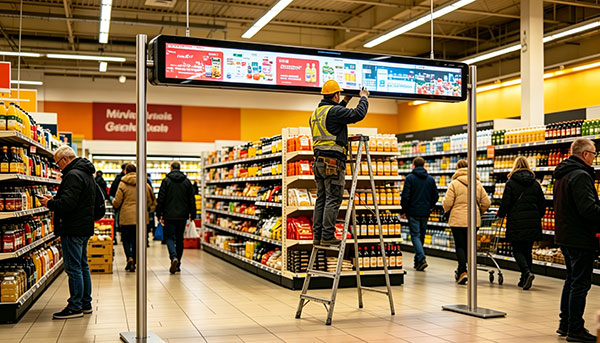
拉伸条形显示器的设计逻辑在建筑上是优雅的:它将死去的房地产——零售货架前部的铝或塑料封檐板——转化为一种主动的沟通媒介,而不会消耗面向产品的空间,破坏货架相邻区域,也不需要对缆车进行结构修改。
竞争性的货架边缘媒体技术——纸质ESL、电子纸电子货架标签和夹式LED显示屏——每种技术都有SBD解决的权衡:
技术 | 颜色能力 | 内容复杂性 | 更新速度 |
纸质标签 | 全彩(静态) | 仅静态打印 | 小时数(重印) |
电子纸ESL | 3-7种颜色(限量) | 文本和;简单图形 | 秒–分钟 |
LED灯带 | RGB(像素限制) | 简单动画 | 实时 |
条形液晶显示器 | 全1670万色 | 视频、动画、丰富数据 | 实时 |
2.零售部署架构
2.1网络拓扑模型
拉伸条形显示器的大幅面零售部署需要一个能够同时处理数千个端点的内容分发架构,价格更新的延迟为亚秒,并与库存和促销管理系统实时同步。我们观察到企业零售中三种流行的拓扑模型:
2.1.1集中式云CMS架构
在此模型中,云托管内容管理系统(CMS)通过受管理的WAN连接与店内媒体播放器聚合器通信。聚合器通过结构化以太网骨干网(通常为Cat 6A)或以太网供电(PoE)结构将内容分发到各个货架边缘显示器。该模型支持企业级活动调度、A/B内容测试和集中审计日志记录。
• 推荐用于:拥有50多个地点和集中营销运营的连锁店
• 延迟配置文件:CMS发布后30-90秒内更新促销内容
• 带宽要求:每家店约2-8Mbps,具体取决于内容复杂性和显示数量
2.1.2边缘计算混合架构
在此模型中,店内边缘服务器处理本地内容渲染、缓存和紧急回退操作,同时与中央云CMS保持同步,以进行活动管理和报告。这种架构在具有可变广域网可靠性的环境中,或者在严格的数据主权要求限制了云依赖性的环境中是首选。
• 建议用于:独立零售商、特许经营商或连接受限的市场
• 延迟配置文件:价格更新在2-15秒内(本地缓存路径)
• 弹性:广域网中断期间,整个商店的运营可维持长达72小时
2.1.3独立本地架构
商店本地服务器管理所有内容操作,不依赖于云。内容通过USB、定时文件传输或存储管理系统集成推送到服务器。这种模式在操作上更简单,但内容更新的手动开销更高。
• 建议用于:单一地点的专业零售商、售货亭运营商或试点部署
2.2内容管理系统要求
为拉伸条显示部署选择的CMS必须解决超宽纵横比带来的独特渲染挑战。为16:9或16:10显示器设计的传统数字标牌平台在没有特定模板支持的情况下,会在SBD面板上产生失真或裁剪错误的内容。
SBD部署的关键CMS能力要求包括:
• SBD纵横比的原生模板创建(包括32:1、24:1、16:1)
• 基于区域的内容分区——用独立的内容项处理单个物理显示器的离散段的能力
• SKU级内容绑定——将产品定价、促销标志和营养数据自动关联到管理每个货架位置的显示节点
• 基于日程安排的分日——基于一天中的时间、一周中的某天和商店交易时段的内容调整
• 通过REST API或MQTT消息传递协议实现实时数据馈送集成
• POS和库存系统连接器(SAP Retail、Oracle Retail、Microsoft Dynamics 365 Commerce和专有零售商ERP环境)
集成说明:ESL桥梁架构 在已经部署了电子货架标签(ESL)网络的零售商中,拉伸条形显示器经常与ESL集成在一起,而不是取代它们。SBD占据货架边缘面板,处理促销内容和富媒体;ESL处理精确的单位级定价和库存数据。共享中间件总线——通常是与零售商定价引擎接口的API网关层——确保两个系统保持同步。这种双通道架构已在多个欧洲和北美市场的杂货店和药房部署中得到验证。 |
2.3物理安装工程
在现有零售环境中物理安装拉伸条形显示器涉及三个主要的工程工作流:结构安装、配电和数据布线。
2.3.1安装和结构注意事项
SBD采用与标准座舱T形槽和C形槽型材兼容的集成安装通道制造。对于新的吊舱安装,OEM货架面板集成(显示屏边框在工厂集成到货架前面板中)提供了最干净的美学,并消除了现场安装的可变性。对于现有吊舱装置的改装部署,可以使用卡扣式或磁性安装系统,但我们建议对长度超过1000毫米的显示器进行机械紧固,以防止随着时间的推移出现振动引起的接触故障。
2.3.2配电
根据面板尺寸和技术,每个显示面板在峰值亮度下的功耗在12W到35W之间。在200个陈列室的安装中,这表示仅陈列室的商店级电力需求为2.4千瓦至7.0千瓦。配电策略包括:
• PoE+(IEEE 802.3at,每个端口30W)——适用于高达700毫米的显示器;消除了单独的电源布线
• PoE++(IEEE 802.3bt,每个端口90W)-适用于更大的显示器和板载计算变体
• 集中式24 VDC配电——在高密度缆车运行中降低每个端口的成本;需要专用电源线束
• 混合PoE+24 VDC——混合显示器尺寸部署中的实用方法
2.3.3电缆基础设施
现场零售环境中货架边缘显示器的数据连接必须适应座舱配置季节性变化,有时甚至每周变化的实际限制。灵活的连接解决方案——包括可伸缩电缆管理系统、模块化机架连接器线束和使用位于吊舱端盖的802.11ax(Wi-Fi 6)接入点的无线最后一跳架构——都在实践中得到了部署。我们的经验表明,有线连接应该是承载实时定价数据的显示器的主要架构,而无线连接则保留用于仅内容频道或备份路径。
3.部署案例研究:杂货行业应用
3.1部署环境
以下案例研究描述了在英国和爱尔兰经营340家门店的一家大型杂货零售连锁店进行的货架边缘拉伸条展示部署。这家零售商经营着一家全方位的杂货店,平均店铺面积为3200平方米,每家店铺的平均SKU数量为22000个。推动SBD部署的主要业务目标是:
• 取消纸质价格标签生产和补货劳动力——估计每家店每周4.2个全职工作小时
• 启用当天促销价格激活,无需现场营销团队亲自访问门店
• 在选择点提供背景产品信息(营养标志、过敏原警告、原产地标签)
• 通过每年在整个庄园消除180万个纸架标签来支持零售商的可持续发展承诺
3.2解决方案架构
部署指定了1000毫米IPS 拉伸条显示 以1920×280的原生分辨率,安装在与零售商的缆车供应商合作开发的定制OEM货架面板上。电源通过安装在吊舱端盖专用网络机柜中的PoE+交换机分配,光纤骨干连接到双冗余店内边缘服务器集群。
内容管理使用集中式云CMS,该CMS通过实时API桥接与零售商的SAP零售定价引擎集成。SAP Retail中发布的价格变化平均在8.3秒内传播到货架边缘显示器。促销内容——动画价格闪光、多购买图形和品牌资产——由中央营销团队通过CMS进行管理,店内管理层保留了店内进度控制。
3.3测量结果
在部署后的24个月内收集了性能数据,并与部署前的基线指标进行了基准比较。记录了以下结果:
+23% 类别转换率上升 | -31% 促销SKU的Markdown频率 | |
8.3秒 平均价格更新延迟 | 94.7% 显示网络正常运行时间(12个月) | |
-1.8米 每年淘汰纸质标签 | +18% 顾客满意度:价格清晰 |
除了上述定量结果外,零售商独立进行的部署后购物者研究发现,67%的受访购物者表示注意到货架边缘的展示,41%的购物者表示动态促销内容影响了他们原本不会做出的购买决定。
The deployment also captured an unanticipated operational benefit: the ability to broadcast real-time stock-out alerts on affected shelf segments, directing shoppers to available substitutes. In trials across 12 stores, this reduced shopper abandonment rate (shoppers leaving without purchasing in a category due to stock-out) by 14%.
Operational Insight: The True Cost of Paper Label Management Pre-deployment time-and-motion studies conducted across 10 pilot stores revealed that paper shelf label management consumed an average of 4.2 FTE hours per store per week — a figure that rose to 7.8 FTE hours during promotional periods when multiple price changes occurred simultaneously. Across a 340-store estate, this represented an annualized labor cost equivalent to the total capital expenditure of the SBD deployment within 26 months. Retailers evaluating SBD ROI should include full labor cost accounting in their business case, not merely media production savings. |
4. Content Design Principles for Stretched Bar Displays
4.1 The Cognitive Constraints of Ultra-Wide Content
Designing content for a 1920×240 pixel display that is physically 1,000 mm wide and 80 mm tall requires a fundamental departure from conventional digital signage design thinking. The extreme aspect ratio creates a content canvas in which the human visual field — approximately 60° of comfortable focus — can only engage with a fraction of the total display width at normal shelf-shopping distance (600–900 mm from panel).
This constraint is not a limitation; it is a design opportunity. The horizontal expanse of the SBD naturally partitions into discrete content zones that can be read sequentially as a shopper traverses the gondola aisle, creating a visual narrative that unfolds over the shopper journey rather than demanding simultaneous attention. We characterize this as the principle of sequential shelf storytelling.
4.2 Recommended Zone Architecture
Based on analysis of eye-tracking data collected across shelf-edge display deployments in grocery and specialty retail environments, we recommend the following zone architecture for a standard 1,000 mm SBD panel:
• Zone A (leftmost 20%, 200 mm): Brand identity — logo, brand color block, category identifier
• Zone B (center-left 35%, 350 mm): Primary product information — product name, key attribute, size/weight
• Zone C (center 25%, 250 mm): Price communication — current price in high-contrast typography, promotional flag if applicable
• Zone D (rightmost 20%, 200 mm): Tertiary information — secondary claim, QR code, loyalty program indicator
This zone architecture should be implemented as a CMS template with data bindings, ensuring that price updates populate Zone C automatically without requiring manual content redesign.
4.3 Typography and Legibility Standards
The compressed vertical height of SBD panels creates strict typographic constraints. For a panel with an 80 mm active area height displayed at 700 cd/m² in a moderately illuminated retail environment (500–1,000 lux), minimum legible character heights are:
• Pricing numerals: minimum 18 mm physical character height (approximately 60px at 1920×240 on 1000mm panel)
• Product name text: minimum 10 mm physical character height
• Supporting text / fine print: minimum 6 mm physical character height
Font selection should prioritize high x-height sans-serif typefaces with open letterforms. Condensed typefaces that appear to save horizontal space frequently reduce legibility in high-ambient-light retail environments due to reduced stroke-to-counter ratio.
4.4 Animation and Motion Guidelines
Motion content on shelf-edge displays must be calibrated against the shopper's movement speed in the aisle. A shopper walking at a typical grocery browsing pace of 0.5–0.8 m/s will traverse a 4-meter gondola run in 5–8 seconds. Animation cycles that complete in under 3 seconds risk displaying incomplete messaging to a moving shopper; cycles exceeding 8 seconds may not complete within the visual engagement window.
We recommend animation cycles of 4–6 seconds for promotional content, with the primary price and product name elements present throughout the full cycle rather than appearing only at cycle completion. Transition effects should use horizontal wipe or fade transitions; vertical transitions conflict with the horizontal orientation of the SBD form factor and create disorienting visual artifacts.
5. Procurement and Vendor Evaluation Framework
5.1 Panel Quality Tier Classification
The stretched bar display market encompasses a wide range of panel quality levels, and the absence of standardized quality tier labeling creates procurement risk for retail buyers. We classify available SBD products into three quality tiers based on objective performance parameters:
参数 | Entry Tier | Mid Tier | Commercial Grade |
平均故障间隔时间 | 20,000–30,000 hr | 35,000–45,000 hr | ≥ 50,000 hr |
Luminance | 300–500 cd/m² | 500–800 cd/m² | ≥ 800 cd/m² (up to 2,500) |
面板类型 | TN | VA | 入侵防御系统 |
亮度均匀性 | < 70% | 70–80% | > 85% |
Operating Hours/Day | 12 hrs/day | 16 hrs/day | 24/7 rated |
保修 | 1 year | 2 years | 3–5 years |
认证 | CE only | CE + FCC | CE, FCC, UL, RoHS + Energy Star |
5.2 RFP Specification Checklist
When issuing an RFP for a stretched bar display deployment, retail technology buyers should require vendors to respond to the following minimum specification points. Responses that omit or provide non-specific answers to these items should be treated as incomplete.
• Panel substrate: confirm single-substrate (not multi-panel assembly) construction
• TCON design: proprietary or OEM; source of TCON and availability of firmware update pathway
• Backlight type: LED; specify local dimming capability and backlight zoning
• Luminance uniformity: measured value across full panel surface at 50% brightness
• Temperature validation: full operating temperature range with test data available on request
• IP rating: display front panel and connector ingress protection rating
• CMS compatibility: confirm integration support for targeted CMS platforms
• Mounting compatibility: confirm compatibility with target gondola profile (provide dimension drawings)
• Power: confirm PoE class and/or DC input voltage; provide power consumption figures at 100% and 50% brightness
• Spare parts availability: committed spare parts availability period post end-of-life
• Deployment references: minimum two verifiable deployment references at comparable scale
6. Regulatory and Compliance Considerations
Retailers deploying stretched bar displays in consumer-facing environments must ensure that both the hardware and operational use of displays comply with applicable regulations. Key compliance areas include:
6.1 Electrical Safety and EMC
All displays deployed in retail environments in the European Union must carry CE marking demonstrating compliance with the Low Voltage Directive (LVD 2014/35/EU) and the Electromagnetic Compatibility Directive (EMC 2014/30/EU). Displays sold or installed in the United States require FCC Part 15 Class B certification for unintentional radiators. Buyers should request Declaration of Conformity documentation from vendors and verify that CE/FCC certification covers the exact product SKU being purchased, not a reference design variant.
6.2 Pricing Legislation Compliance
In jurisdictions where price display regulations require the displayed price to be the price charged at the point of sale — including the EU Price Indication Directive (98/6/EC) and various national implementations — the latency characteristics of the SBD network have direct legal implications. If a price promotion activates in the POS system before the shelf-edge display has updated, the retailer may be legally obligated to honor the lower price shown. Buyers should document the maximum acceptable latency for their regulatory environment and specify this in their SBD CMS SLA with their technology provider.
6.3 Data Privacy
Some advanced SBD deployments integrate audience analytics capabilities — anonymous footfall counting, dwell time measurement, demographic inference — using camera sensors mounted near display panels. Deployments incorporating any form of camera-based analytics in GDPR-regulated jurisdictions require privacy impact assessments, appropriate privacy notice signage, and in certain interpretations, explicit opt-in consent mechanisms. We recommend that retailers seek legal counsel before enabling any analytics capability beyond basic display performance monitoring.
7. Conclusions and Recommendations
The stretched bar display has matured from a specialist niche technology into a commercially proven, infrastructure-grade solution for retail shelf-edge communication. Deployment evidence from grocery, pharmacy, and specialty retail environments consistently demonstrates measurable commercial return on investment across conversion rate, promotional effectiveness, operational labor, and shopper satisfaction dimensions.
For retail technology decision-makers evaluating SBD deployments, we offer the following consolidated recommendations:
1. Specify commercial-grade IPS panels (≥ 800 cd/m², ≥ 50,000 hr MTBF) for all environments with operating hours exceeding 16 hours per day or ambient illumination above 1,000 lux.
2. Architect your CMS integration with a direct API connection to your pricing engine from day one. Retrofitting real-time pricing integration to an existing SBD deployment is significantly more complex than building it into the initial deployment.
3. Conduct a gondola survey before finalizing panel sizing specifications. Standard panel lengths may not align with every gondola configuration in your estate; custom lengths incur lead-time and cost premiums that must be factored into project planning.
4. Invest in content template development before hardware rollout. The most common cause of underperforming SBD deployments is the application of conventional digital signage creative to an SBD format without adaptation for the extreme aspect ratio and shopper engagement model.
5. Plan for a phased deployment model. Begin with a high-traffic category or store zone to establish operational process, train store staff, and refine content before estate-wide rollout.
Next Steps For retailers and retail technology integrators seeking to explore a stretched bar display deployment, we recommend beginning with a structured feasibility assessment covering gondola inventory, network infrastructure, CMS compatibility, and commercial objective alignment. Our technical team provides no-obligation feasibility assessment engagements for qualified retail operators. Contact our retail solutions practice to arrange an initial consultation. |
Appendix A: Glossary of Key Terms
参数 | 规格/值 |
CMS | Content Management System — software platform managing digital signage content scheduling, distribution, and playback |
ESL | Electronic Shelf Label — wireless, low-power display device used for unit-level price display at retail shelf positions |
入侵防御系统 | In-Plane Switching — LCD panel technology offering wide viewing angles and superior color accuracy versus TN/VA alternatives |
平均故障间隔时间 | Mean Time Between Failures — statistical measure of hardware reliability; expressed in operating hours |
PoE / PoE+ | Power over Ethernet / Power over Ethernet Plus — IEEE standards enabling power delivery over Cat 5e/6 data cabling |
SBD | Stretched Bar Display — LCD panel with extreme aspect ratio (7:1 to 32:1) optimized for shelf-edge and narrow-format applications |
SKU | Stock Keeping Unit — unique identifier for a distinct product and packaging configuration within a retail inventory system |
TCON | Timing Controller — integrated circuit managing pixel addressing and signal timing within an LCD panel |
TN | Twisted Nematic — LCD panel technology; lowest cost, limited viewing angle and color accuracy |
VA | Vertical Alignment — LCD panel technology; higher contrast than IPS, narrower viewing angle |
WAN | Wide Area Network — communications network connecting geographically distributed retail locations to central systems |
This white paper is produced for B2B informational purposes. All deployment figures, case study data, and performance metrics
are derived from real-world deployments and anonymized in accordance with client confidentiality agreements.
© 2026 | All rights reserved | Unauthorized reproduction prohibited