城市轨道交通中的条形显示器:乘客信息系统的完整技术解决方案
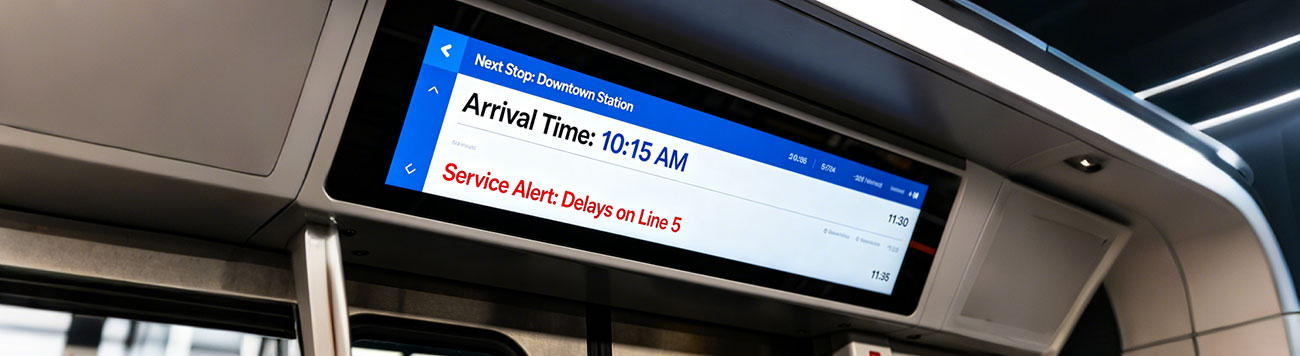
应用场景:车载和;地铁和快速公交网络的站台乘客信息系统(PIS)
挑战:为什么标准显示器在交通环境中失败
升级乘客信息系统的公交运营商总是遇到同样的问题:车厢或站台边缘的物理几何形状根本无法容纳传统的16:9屏幕。地铁车厢天花板从扶手面板到顶板大约有200-250毫米深。挡风玻璃上方的公共汽车顶盖面板提供的垂直间隙更小。在任何一个位置安装标准的1080p显示器都需要三种折衷方案之一——截断内容,将其信箱成乘客忽略的细带,或者在标题上级联多个小屏幕,增加布线、媒体播放器和故障点。
在评估了来自三大洲十几家供应商的硬件后,工程结论是一致的:具有原生超宽纵横比的专用拉伸条LCD是唯一一种在不牺牲易读性、耐用性或内容丰富性的情况下解决尺寸限制的显示技术。
显示器规格:什么;加长杆";实际上,交通工具
A. 拉伸条液晶显示器 (也称为条形显示器或条形显示器)的原生面板纵横比通常在 32:9和16:4.5与16:9的标准相反。常见的运输坡度尺寸包括:
| 面板尺寸 | 本机分辨率 | 宽高比 | 典型的交通使用 |
|---|---|---|---|
| 28" | 1920 × 360 | 16:3 | 公交车下一站显示,头顶 |
| 37.5" | 2560 × 720 | 32:9 | 地铁车厢侧板 |
| 47" | 3840 × 1080 | 32:9 | 站台边缘/车站大厅 |
| 23.1" | 1920 × 360 | 16:3 | 火车车厢行李架条 |
不同于";削减";面板——它们是标准的LCD玻璃,机械地修剪成更窄的尺寸——原生拉伸面板是专门设计的,从背光到驱动器IC。这种区别在操作上很重要:切割面板在切割边缘产生微断裂的风险增加,在终点处出现轻微出血,在轨道和公路交通中常见的振动载荷下MTBF降低。来自一级制造商(BOE、Innolux、AUO)的原生面板具有与其标准格式等效物相同的结构完整性评级。
对于运输级采购,请在RFQ中明确指定本地面板结构。它是长期可靠性最重要的单项。

技术架构:PIS集成蓝图
基于拉伸条形显示器构建的功能性车载PIS不仅仅是一个硬件选择练习。这是一个系统集成问题,显示器是更广泛的数据管道的输出层。
1.数据输入层
显示器必须从两个主要来源摄取实时数据:
AVL/GPS馈送 (自动车辆位置):提供当前位置,系统将其与GTFS(通用交通馈电规范)静态时间表进行交叉引用,以计算下一站、估计到达时间和连接信息。
调度/CAD系统:提供服务警报、延迟通知、紧急消息和操作员发起的内容覆盖。
In modern deployments, this data is pushed to the display controller via 4G/5G cellular modem (primary) with Wi-Fi handoff at termini for bulk content sync. The fallback is always pre-loaded static route content stored on the onboard media player, ensuring the display continues to show useful information even during connectivity loss — a scenario that occurs frequently in underground metro tunnels.
Protocol note: GTFS-Realtime over HTTP/protobuf is the current North American standard. European operators increasingly use SIRI (Service Interface for Real-time Information) XML feeds. A well-specified PIS display controller handles both, and procurement specs should require it.
2. Display Controller / Embedded Media Player
Each stretched bar unit integrates an embedded Android (12 or higher) or Linux-based media player. Minimum spec for a viable transit deployment:
SoC: Rockchip RK3568 or equivalent (quad-core ARM Cortex-A55, 2GHz)
RAM: 4 GB LPDDR4
Storage: 32 GB eMMC (sufficient for 72-hour offline content cache)
Interfaces: HDMI in, USB-A ×2, RJ45, RS485 (for legacy bus intercom integration)
OS: Android 12 or Debian-based Linux (Android preferred for CMS ecosystem compatibility)
The controller handles multi-zone content rendering: a single 3840×1080 panel is logically partitioned into independent zones — for example, a next-stop animation on the left 60%, a live clock on the right 20%, and a scrolling service alert ticker at the bottom edge. Each zone updates independently without requiring a full-screen content refresh.
3. Content Management System (CMS) Integration
Centralized fleet management operates through a cloud-based CMS that communicates with each vehicle's display controller via the cellular modem. Standard functionality includes:
Remote content push: Update promotional content, service maps, emergency notices across an entire fleet within minutes
Scheduling by route/vehicle/time-of-day: Rush-hour messaging differs from off-peak; door-side panels can show directional content based on which side of the vehicle is at the platform
Diagnostic telemetry: Display brightness, uptime, connectivity status, and fault codes reported back to the operations center in real time
OTA firmware updates: Critical for maintaining security compliance without requiring vehicles to be pulled from service
The CMS integration layer is where many deployments fail. The display must expose a documented API (REST or MQTT) for CMS connectivity, and the vendor must provide active SDK support. This is a procurement qualification criterion, not a nice-to-have.
4. Physical Integration and Mounting
Transit cabin installation introduces mechanical constraints that differ fundamentally from static retail or architectural signage environments:
Vibration tolerance: IEC 60068-2-64 specifies random vibration test profiles for transport equipment. Displays deployed on buses and rail cars must meet relevant sub-categories (road vehicles: 5–150 Hz swept sine; rail: EN 50155 Category 1). Request test certificates from any supplier as part of qualification.
Temperature range: Vehicle cabins can reach +65°C in summer (particularly in door-adjacent zones) and drop to -25°C in overnight storage in cold climates. The rated operating range for transit displays should be -20°C to +70°C at minimum, with storage ratings extending further.
Ingress protection: Bus header positions are exposed to passenger-generated humidity, cleaning fluid overspray, and occasional splash. IP54 minimum is appropriate; IP65 is preferable for driver-area or door-adjacent installations.
Mounting hardware: Overhead installations require anti-vibration isolation mounts. The display chassis should include integrated VESA-compatible mounting points and, for installations above seated passengers, secondary retention cables rated to a minimum of 5× the display weight — a requirement in most European and North American transit safety standards.
亮度: Platform-edge and window-facing installations demand high-brightness panels. A minimum of 1000尼特 is required for legibility in direct sunlight ingress; 1,500 nits is the recommended specification for south-facing platforms in temperate climates.
Operational Performance: What the Numbers Look Like
A properly specified stretched bar PIS deployment delivers measurable outcomes across three dimensions:
Passenger experience: Real-time next-stop and connection information reduces passenger-initiated driver communications by approximately 40% in initial post-deployment periods (a figure consistently cited in transit authority operational reports from UK and Scandinavian networks following PIDS upgrades). For operators managing multi-language passenger populations, on-screen multilingual capability eliminates the need for separate text displays and reduces regulatory compliance overhead.
Operational efficiency: Dynamic content routing allows operators to redirect messaging in real time during service disruptions — re-routing instructions, alternative stop information, and emergency notices reach passengers on board before they reach the affected stop. This reduces platform crowding events and associated safety incidents.
Maintenance cost: A daisy-chain installation topology — one media player driving up to 12 displays via serial video output — reduces per-vehicle controller count from one per display (the legacy approach with independent monitors) to one per zone. Across a fleet of 200 vehicles, this reduction in controller hardware and associated cabling represents a significant lifecycle cost saving.
Common Deployment Pitfalls and How to Avoid Them
Pitfall 1: Specifying cut-panel displays to reduce unit costThe immediate cost saving is typically 15–25% per unit. The lifecycle cost penalty — from higher failure rates, more frequent warranty claims, and panel replacement at year 2–3 rather than year 5–7 — consistently exceeds the initial saving in transit deployments where vibration loads are continuous. Specify native panel construction.
Pitfall 2: Underspecifying the CMS APISelecting a display based on hardware spec alone, then discovering that the vendor's CMS is a closed ecosystem incompatible with the operator's existing fleet management platform, is the most common cause of project delay and cost overrun. Define CMS integration requirements — protocol, authentication, data schema — before shortlisting display vendors.
Pitfall 3: Ignoring EMC complianceDisplays in transit vehicles must meet electromagnetic compatibility standards to avoid interfering with radio communications equipment, passenger Wi-Fi, and ATC (Automatic Train Control) systems. In North America, FCC Part 15 applies; in Europe, EN 55032 is the relevant standard. Displays not tested and certified to these standards cannot legally be installed in commercial transit vehicles in most jurisdictions.
Pitfall 4: Oversizing for the spaceA 47" panel is not inherently superior to a 37.5" in a bus cabin. Oversizing increases weight load on the mounting structure, consumes more power (relevant for electric vehicle range calculations), and can compromise passenger headroom clearance requirements. Dimensional analysis against the specific vehicle model is a prerequisite for hardware selection, not an afterthought.
Procurement Checklist for Transit PIS Buyers
When issuing an RFQ for 拉伸条显示 panels for a transit PIS application, require the following documentation from vendors:
Native panel construction confirmation from panel manufacturer (BOE, Innolux, AUO, or equivalent tier-1)
IEC 60068-2-64 vibration test certificate (specify relevant vehicle category)
Operating temperature range certificate (-20°C to +70°C minimum)
Ingress protection rating certificate (IP54 minimum)
EMC compliance certificate (FCC Part 15 / EN 55032 as applicable)
MTBF data at rated operating temperature (50,000 hours minimum for LED backlight)
CMS API documentation (REST/MQTT, authentication method, schema)
GTFS-RT and SIRI feed compatibility confirmation
Sample fleet reference (minimum 50 vehicles, 12 months operational)
Spare parts availability commitment (minimum 7 years post-purchase)
Conclusion
The stretched bar display is not simply a niche format curiosity. In transit PIS applications, it is the geometrically and technically correct solution to a problem that standard 16:9 displays cannot solve without compromising either the installation environment or the content experience. The technology is mature, the supply chain is established at scale, and the integration frameworks — GTFS-RT, SIRI, Android CMS, REST APIs — are well-documented.
The differentiating factor between a successful deployment and a costly retrofit is the thoroughness of specification at procurement. Operators and integrators who approach the display as a system component — defining vibration tolerance, CMS compatibility, EMC compliance, and panel construction type before selecting a vendor — consistently achieve the operational outcomes the technology is capable of delivering.
For transit networks currently operating static or legacy PIDS infrastructure, the business case for migration to native stretched bar LCD systems is robust. The hardware cost is recoverable; the passenger experience and operational efficiency gains are not achievable through any other means within the physical constraints of modern vehicle design.
For technical specifications, custom panel sizing, and fleet integration consulting, contact our engineering team to discuss your specific deployment requirements.