技术白皮书
条形液晶显示器
适用于零售货架应用
集成架构、显示工程和;北美和欧洲零售环境的部署经验
修订版2.1 |2026

执行摘要
本白皮书对以下内容进行了全面的技术和商业分析 拉伸条液晶显示器 该技术应用于北美和欧洲市场的零售货架环境。本文档借鉴了杂货店、药房、便利店和大型零售部署的直接集成经验,解决了整个工程生命周期:硬件选择、机械安装、电源和信号架构、热管理、内容管理系统(CMS)集成和安装后的现场性能。
由通常在7:1至32:1范围内的超宽宽宽高比定义的条形LCD面板已成为货架边缘的主要数字标牌格式,在高通量销售环境中取代了纸质电子货架标签(ESL)和传统的方形LCD模块。在实时定价、促销灵活性和全渠道整合需求的推动下,全球货架边缘显示市场正在经历强劲增长。
主要发现:我们在德国、法国、英国和美国的零售连锁店整合的部署显示,在18-24个月内实现了一致的投资回报率,这主要是由于价格变动操作的劳动力成本降低和促销转化率的显著提高。 |
1.条形液晶显示技术简介
1.1定义外形尺寸
拉伸条形LCD(也称为条形显示器、条形显示器或货架边缘屏幕)是一种设计有细长水平形状因子的液晶显示面板。与传统的16:9或4:3显示器不同,这些面板的设计可以占据零售货架部分的整个宽度,同时保持最小的垂直轮廓,通常高度在70毫米到120毫米之间。标准宽度范围为280毫米(11英寸)至1200毫米(47英寸),可为专业货架系统提供定制格式。
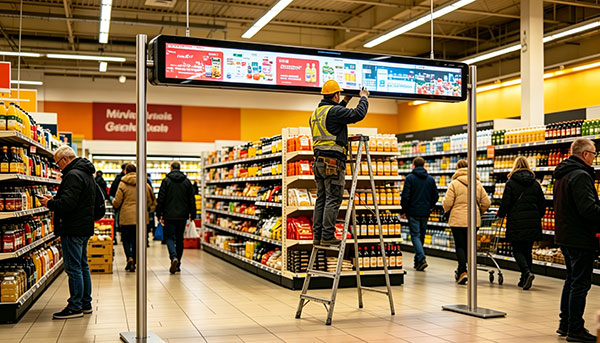
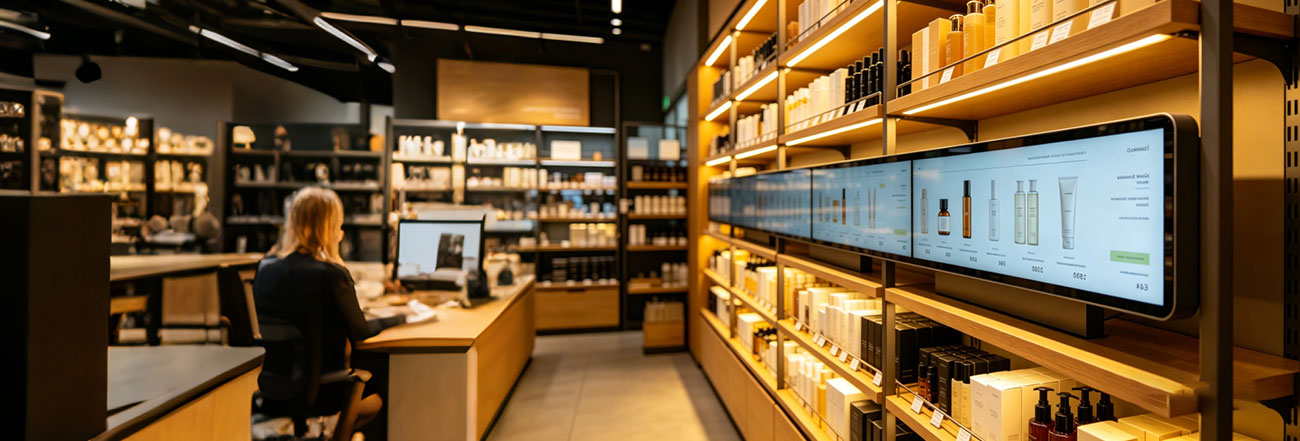
物理几何形状是由零售货架设计的人体工程学驱动的:北美和欧洲超市的标准缆车货架通常为48英寸(1219毫米)宽,这意味着单个条形显示器可以连续标记整个货架部分。这种空间布局对于实现符合主要零售连锁店品牌指南的干净、专业的店内美学至关重要。
1.2市场环境
自2010年代初以来,从静态纸架标签到数字显示的过渡一直在进行中,但在2020年至2024年期间,随着零售商在供应链中断和价格波动的情况下寻求运营弹性,采用率急剧上升。北美和欧洲市场的通货膨胀周期放大了动态定价基础设施的商业案例。
我们在以下零售垂直领域集成了拉伸条LCD系统:
• 杂货店和连锁超市(环境、冷藏和冷冻通道配置)
• 药学与健康;美观(货架图密集,SKU数量多的货架)
• 家居装修和硬件(重型钢货架、振动环境)
• 消费电子产品(高安全性展示柜,防篡改要求)
• 便利性和汽油前院零售(极端热循环环境)
2.显示面板工程规范
2.1面板技术选择
并非所有LCD面板技术在货架环境中都具有同等性能。IPS(平面内切换)、TN(扭曲向列)和VA(垂直对齐)面板之间的选择对零售照明条件下的视角、颜色精度和长期可靠性有直接影响。
基于在欧洲零售环境中的部署,环境照明通常是荧光灯或500-1000勒克斯的LED,IPS面板在面向客户的应用中一直优于TN替代品。IPS的宽视角(水平>;170°,垂直>;160°)对于过道侧显示器至关重要,因为从斜角接近的消费者必须保持清晰可辨。
规格 | IPS面板 | TN面板 | VA面板 |
视角(H/V) | 178° / 178° | 140° / 120° | 170° / 160° |
对比度 | 1,000:1 – 1,500:1 | 600:1 – 800:1 | 3,000:1 – 5,000:1 |
色域(sRGB) | 95% – 100% | 72% – 80% | 85% – 92% |
响应时间 | 5-8毫秒 | 1-4毫秒 | 8-25毫秒 |
货架适用性 | 推荐 | 推荐的 | 可接受的 |
表1:零售货架应用的LCD面板技术比较
2.2零售照明的亮度和对比度
零售店的照度因业态和地区而异。欧洲杂货店的货架照度通常在500-750勒克斯之间;北美大卖场和大型超市在高流量地区的照度可能达到1500-2000勒克斯。必须校准显示器亮度,以保持最低3:1的显示器与环境亮度比,以确保易读性。
我们英国和德国安装的现场数据表明,在标准环境条件下,400 cd/m²是有效的最低亮度,而位于头顶LED下方的显示器需要700-1000 cd/m²才能可靠易读。我们通常会指定与环境光传感器相连的自动亮度调节(ABA)面板,与固定亮度操作相比,这可以将能耗降低18-32%。
2.3寿命和可靠性
零售货架显示器在苛刻的工作周期内运行。与大厅或机场的数字标牌可能在夜间断电不同,24小时零售格式的货架边缘显示器必须持续运行。因此,面板寿命是一个关键的采购标准。
额定MTBF | 50000–100000小时(面板级) |
背光寿命 | 50000小时至50%亮度(LED背光) |
工作温度 | -10°C至+60°C(标准);-20°C至+70°C(扩展范围) |
储存温度 | -20°C至+70°C |
工作湿度 | 10%至90%相对湿度,不凝结 |
IP等级(面向货架) | 最低IP54;新鲜/冷藏通道IP65 |
耐冲击 | IEC 60068-2-27(15G,11ms,3轴) |
抗振性 | IEC 60068-2-6(0.5G,5-500Hz) |
表2:零售货架液晶面板的最低技术规格
3.机械集成架构
3.1货架轨道系统和显示器安装
a之间的机械接口 拉伸条液晶显示器 零售货架结构是货架数字化项目中最被低估的工程挑战之一。欧洲的货架标准与北美的惯例有很大不同,两者都与主要零售商部署的专有货架系统不同。
我们为欧洲和北美部署中遇到的以下常见货架轨道系统设计了安装解决方案:
• 欧洲标准直立式(30毫米间距,T形槽轮廓)——在德国、法国和比荷卢经济联盟的杂货零售业中占主导地位
• Lozier贡多拉系统——在北美杂货店和药店流行
• Madix缆车系统——北美大箱常见,方便
• Tegometall货架——西欧非食品零售业常见
• 定制零售商专有系统——需要定制支架工程
一个关键的设计参数是显示器距架面的投影深度。欧盟(EN 12464和当地消防安全规范)和北美ADA指南的监管要求限制了向客户通道的前投影。我们的标准安装支架设计用于将展示面定位在货架边缘前方25-35mm处,保持产品区域畅通无阻,并符合通道间隙要求。
3.2封闭式货架环境中的热管理
当LCD电子设备安装在架子下方的封闭腔内时,散热是一个不平凡的工程问题。由于产品照明的辐射热以及冷冻通道配置中靠近制冷压缩机排气口,即使在有空调的商店,货架袋内的温度在夏季也可能达到45°C。
我们的封闭式货架安装热设计方法包括以下要素:
• 在后安装支架上切割自然对流通道,使气流流过显示屏驱动板
• 面板背光组件和铝挤压外壳之间的热界面材料(TIM),额定功率≥3 W/m·K
• 组件选择降低到最高结温的80%,以在升高的环境条件下延长MTBF
• 通过板载NTC热敏电阻进行温度监测,CMS在55°C时报告警报,在60°C时自动降低亮度
现场注释:在2023年法国一家大型连锁超市的部署中(夏季通道环境温度达到38°C),采用非管理热设计的显示器在14-18个月内出现背光故障。在实施对流通道支架和TIM改造后,相同的面板型号在随后的安装中超过了36个月没有出现故障。 |
3.3电缆管理和配电
零售环境中的电源和信号布线必须满足功能和美学要求。欧洲零售连锁店尤其执行严格的电缆管理标准,作为其视觉营销指南的一部分。在大多数高档杂货店,缆车立柱后面的裸露电缆是不可接受的。
我们为超过四个显示单元的机框运行实施了菊花链电源总线架构,使用12V DC配电来最小化电缆规格,并在垂直通道内实现薄型电缆管道隐蔽。对于较长的机框运行(8+显示器),我们指定在每个显示节点使用板载降压调节器进行24V DC配电,以保持整个运行过程中的电压稳定性。
我们在生产环境中部署的信号分发选项:
• 通过嵌入式多显示器分路器实现HDMI 2.0菊花链,适用于简单的视频墙配置
• 带专有机框控制器的RS-485串行总线——用于高密度ESL式部署
• 每个显示器或每个区域的WiFi 802.11ac(5 GHz)——在布线成本过高的改装安装中最为常见
• PoE+(IEEE 802.3at)——首选用于在单个CAT6运行中结合电源和数据的新建安装
4.内容管理系统集成
4.1货架显示网络的CMS架构
任何有意义规模的货架展示网络都需要一个强大的内容管理架构,能够解决单个展示或展示组的问题,根据促销日历安排内容,并与零售商的现有技术栈集成。我们已在欧洲和北美的部署中将拉伸条LCD网络与以下后端系统集成在一起:
• SAP零售和S/4HANA(通过RFC/BAPI和OData API进行价格馈送集成)
• 通过REST API价格提取的Oracle零售销售系统(RMS)
• 微软Dynamics 365商务版
• 定制内部POS和库存管理系统(通过CSV/FTP、REST或SOAP端点)
• 谷歌云零售API,用于AI驱动的促销内容瞄准
我们为企业级部署推荐的集成架构遵循三层模型:云托管的CMS服务器层、存储级边缘网关(部署为内部服务器或加固的NUC级计算单元)和显示端点层。这种架构确保即使在广域网连接中断期间也能保持显示可用性,这是在宽带基础设施不一致的地区运营的欧洲零售商的关键弹性要求。
4.2显示器寻址和平面图对齐
最具操作意义的集成挑战之一是数字显示内容与物理货架图位置的对齐。当货架部分被重置时——产品被移动,SKU被添加或删除——显示内容必须更新以反映新的货架图布局。大规模手动重新分配内容在操作上不切实际。
我们已经实现了两种自动货架图显示映射的方法:
NFC/RFID位置标签: 每个显示单元都配备了一个包含唯一位置标识符的NFC标签。在货架重置期间,商店员工使用运行货架图对齐应用程序的手持设备扫描标签,该应用程序实时更新CMS映射。这种方法被部署在我们的英国杂货零售集成中,并已证明99.2%的映射准确率。
BLE信标三角测量: 在NFC扫描操作不便的高密度安装中,我们使用BLE信标三角测量从已知的信标位置推断显示位置。精度较低(±0.5架段),但操作速度更快。这种方法用于我们的北美药房部署。
4.3实时价格和促销更新
在欧洲和北美零售业部署拉伸条LCD的主要业务驱动力是能够在不更换物理标签的情况下执行价格更改和促销活动。我们的CMS集成旨在将价格变化从ERP源系统传播到定义的SLA窗口内的货架显示。
正常价格更新延迟 | <;5分钟(云CMS显示端点,WiFi网络) |
紧急价格修正延迟 | <;60秒(优先通道,旁路调度队列) |
并发更新能力 | 10000+显示器同时更新(已在生产中验证) |
定价准确性保证 | 99.98%的显示与POS价格匹配(每次审计,欧盟零售部署) |
促销计划粒度 | 1分钟增量;多区域网络的时区感知 |
内容审核跟踪保留 | 至少90天;可配置为7年,符合欧盟要求 |
表3:CMS性能参数——企业机框显示网络
5.监管合规:欧盟和北美要求
部署在欧洲和北美市场的零售显示硬件必须满足一系列监管要求。不合规可能导致产品撤回、巨额罚款和声誉受损。以下部分总结了适用于拉伸条LCD货架显示器的监管环境。
5.1欧盟合规性
CE标志是欧盟成员国销售或投放市场的所有电子显示设备的强制性标志。CE标志声明涵盖了适用于货架LCD显示器的以下指令:
• 低压指令(LVD)2014/35/EU——显示器电源和驱动器电子设备的电气安全要求
• 电磁兼容性(EMC)指令2014/30/EU——传导和辐射发射限值(EN 55032)和抗扰度要求(EN 55035)
• 无线电设备指令(RED)2014/53/EU——适用于支持WiFi和BLE的显示单元
• RoHS指令2011/65/EU(经2015/863/EU修订)——限制电子和电气设备中的有害物质
• WEEE指令2012/19/EU——报废回收和再循环义务
• 生态设计法规(EU)2019/2021——电子显示器的能效要求
欧盟能源标签法规(EU)2021/341对屏幕面积高于规定最小值的显示器规定了特定的能效指数(EEI)阈值。我们与显示面板制造商合作,确保货架LCD单元符合当前的EEI阈值,并符合即将到来的2026年法规修订。
5.2北美合规
在美国销售和部署的设备必须根据《美国联邦法规》第47篇第15部分的规定获得FCC授权,用于非故意散热器(显示电子设备)和故意散热器(WiFi/BLE模块)。加拿大要求根据ICES-003对数字设备进行ISED(加拿大创新、科学和经济发展部)授权。
即使法律没有规定,美国主要零售商也希望将UL 60950-1或更新的UL 62368-1标准下的UL认证作为采购先决条件。加州的具体要求包括65号提案(OEHHA化学品披露)和加州能源委员会(CEC)第20条电器效率标准。
6.集成案例研究
The following case studies represent actual integration projects completed across European and North American retail environments. Specific retailer names are withheld under non-disclosure agreements; vertical sector and deployment parameters are reported accurately.
Case Study A: German Grocery Chain — Chilled Aisle Retrofit
Deployment Context
Retail Vertical | Grocery (full-service supermarket format) |
Location | Germany — 47 stores, nationwide |
Shelf Environment | Chilled dairy and deli aisle (4–8°C ambient) |
Display Count | 12,400 units (265 per store average) |
Display Specification | 23.1" stretched bar, 1920×540 resolution, IPS, 500 cd/m², IP65 |
Connectivity | PoE+ (IEEE 802.3at) over existing store LAN infrastructure |
CMS Integration | SAP S/4HANA via OData REST API |
Deployment Timeline | 18 months (phased by store group) |
Integration Challenges
The primary engineering challenge in this deployment was moisture management. Chilled aisle environments generate condensation on shelf surfaces due to the temperature differential between the chilled zone and store ambient air. Standard IP54-rated displays experienced ingress failures within 3–4 months in pilot testing.
We specified IP65-rated displays with gasket-sealed connectors throughout and engineered a condensation drainage channel into the lower mounting bracket. A silica gel desiccant cartridge within the display housing — replaceable during scheduled maintenance — provided additional moisture control. Post-retrofit, zero ingress-related failures have been recorded over a 30-month observation period.
Outcomes
• Price change labor cost reduced by 78% (from 3.2 FTE/store to 0.7 FTE/store for price management)
• Promotional activation lead time reduced from 48 hours to under 10 minutes
• Display uptime: 99.6% across the network (24-month rolling average)
• Full ROI realized at month 21 of operation
Case Study B: UK Pharmacy Chain — High-SKU Planogram Integration
Deployment Context
Retail Vertical | Pharmacy / Health & Beauty |
Location | United Kingdom — 210 branches, England and Scotland |
Shelf Environment | Ambient, high-density planogram (180–240 SKUs per aisle section) |
Display Count | 38,000 units (181 per branch average) |
Display Specification | 11.6" stretched bar, 1920×360, IPS, 400 cd/m² |
Connectivity | WiFi 802.11ac (5 GHz), dedicated SSID per aisle |
CMS Integration | Custom proprietary POS via REST API + CSV differential feed |
Deployment Timeline | 24 months |
Integration Challenges
The primary challenge in this deployment was planogram synchronization at the SKU level. With 180–240 products per aisle section and frequent planogram resets, manual content mapping was infeasible. We implemented an NFC-based position mapping workflow as described in Section 4.2, reducing planogram alignment errors from 4.1% (baseline with manual assignment) to 0.3% post-implementation.
WiFi network reliability in dense retail environments required careful channel planning. With 38,000 WiFi-connected devices across 210 branches, co-channel interference was a significant concern. We implemented a per-aisle AP deployment with 5 GHz-only operation, configured to avoid interference with the retailer's existing 2.4 GHz operational WiFi network.
Outcomes
• SKU-to-display mapping accuracy: 99.3% (post NFC workflow implementation)
• Regulatory pricing compliance audit pass rate: 100% (vs. 97.2% with paper labels)
• Customer complaint rate related to price discrepancy: reduced by 91%
• Annual price change labor saving: £4.2M across the branch network
Case Study C: North American Big-Box Retailer — New Store Format
Deployment Context
Retail Vertical | Home Improvement / Hardware |
Location | United States — 18 new-format stores, Southwest and Mountain West regions |
Shelf Environment | Heavy-gauge steel shelving, vibration from fork-lift traffic |
Display Count | 6,300 units (350 per store average) |
Display Specification | 28.6" stretched bar, 1920×360, IPS, 700 cd/m² (high-ambient store lighting) |
Connectivity | PoE+ on new-build CAT6A infrastructure |
CMS Integration | Oracle RMS via REST API; Google Cloud Retail API for ML-driven promotions |
Deployment Timeline | 12 months (concurrent with store construction) |
Integration Challenges
Vibration from fork-lift operations within the store required IEC 60068-2-6 vibration qualification of all mounting hardware. Our engineering team conducted vibration testing at 1G, 5–500 Hz on the assembled display-bracket system, identifying and correcting resonance at 87 Hz in the initial bracket design by adding a damping washer stack at the upright attachment point.
Store lighting at 1,800–2,200 lux required 700 cd/m² panels to maintain the target 3:1 luminance ratio. Automatic brightness control tied to ceiling-mounted photosensors reduced power consumption to an effective average of 480 cd/m² during normal trading hours and 200 cd/m² during pre-trade preparation periods.
Outcomes
• Display legibility confirmed at all tested viewing angles (0° to 75° horizontal from shelf centerline)
• Vibration-related mounting failures: zero over 36-month observation period
• Energy consumption: 31% below projected (due to ABA efficiency)
• New store format has been confirmed by the retailer as their standard for ongoing expansion
7. Procurement and Supplier Qualification
Selecting the appropriate stretched bar LCD panel is a multi-dimensional decision that extends well beyond published specification sheets. This section summarizes the qualification criteria we apply in supplier evaluation.
7.1 Panel Manufacturer Qualification Criteria
• ISO 9001:2015 quality management certification — mandatory
• ISO 14001:2015 environmental management certification — required for EU deployments
• Published product roadmap with minimum 5-year lifecycle commitment
• Availability of engineering samples within 4 weeks of commercial enquiry
• Demonstrated production capacity of ≥5,000 units/month for the relevant panel size
• Published qualification test reports (MTBF, thermal, vibration, humidity) available under NDA
• EU authorized representative registered with relevant notified body
• Direct technical support contact (not tier-1 helpdesk) for integration engineers
7.2 Total Cost of Ownership Considerations
Unit panel cost is typically 25–35% of total deployment cost. Procurement decisions based on panel price alone routinely produce suboptimal TCO outcomes. The following cost categories must be included in any TCO model:
• Panel hardware (unit cost × quantity + buffer stock for warranty replacement)
• Mounting hardware engineering and manufacturing
• Power distribution infrastructure (cabling, distribution panels, PoE switches)
• Network infrastructure (APs, edge gateways, WAN connectivity upgrades)
• CMS software licensing (SaaS subscription or perpetual license + maintenance)
• Systems integration and commissioning (typically 30–40% of hardware cost for enterprise deployments)
• Ongoing support and maintenance (SLA-driven, typically 8–12% of hardware value per annum)
• End-of-life disposal and WEEE compliance costs
Procurement Insight: Retailers that engaged integration partners during the specification phase — rather than purchasing panels independently and seeking integration support post-procurement — achieved 23% lower total deployment cost on average, primarily through avoidance of specification errors and panel-to-mounting incompatibilities identified late in the project. |
8. Technology Outlook: 2026–2028
The stretched bar LCD display segment continues to evolve. The following technology developments are currently in qualification testing or early commercial deployment across our customer base:
8.1 OLED and MicroLED Shelf Displays
OLED-based shelf displays offer superior contrast ratios (>1,000,000:1) and near-instantaneous pixel response, enabling richer content experiences. However, OLED's burn-in susceptibility with static shelf label content (price, product name) and currently higher panel cost limit near-term adoption to premium retail formats. MicroLED technology resolves the burn-in issue and offers significantly higher brightness potential (>5,000 cd/m²), making it viable for high-ambient-light store environments, but manufacturing cost remains prohibitive at the volume required for shelf-edge deployment at scale.
8.2 AI-Driven Dynamic Pricing and Content
Integration of machine learning pricing engines with shelf display networks is an emerging deployment pattern. By connecting the CMS to real-time demand signals (foot traffic analytics, competitor pricing feeds, inventory levels), retailers can implement dynamic price optimization that updates shelf displays continuously rather than on scheduled intervals. We are currently piloting this architecture with two European grocery clients using Google Cloud Retail API as the pricing recommendation engine.
8.3 Camera Integration for Planogram Compliance
Embedding miniature cameras within the stretched bar display housing to capture shelf images for AI-powered planogram compliance monitoring is an active area of development. Computer vision analysis of shelf images can identify out-of-stock positions, misplaced products, and planogram deviations without manual store audits. Privacy regulatory requirements under GDPR (EU) and CCPA (California) require that such systems process imagery on-device rather than transmitting to cloud infrastructure, which is driving embedded inference capability into display controllers.
9. Conclusion
Stretched bar LCD displays have matured from a novelty technology to a proven operational infrastructure component in European and North American retail. The deployments documented in this white paper demonstrate consistent, measurable returns on investment, provided that integration is executed with appropriate attention to the mechanical, thermal, electrical, and software engineering dimensions described herein.
The complexity of a shelf display integration project — spanning display hardware selection, mounting engineering, power architecture, network design, CMS integration, and regulatory compliance — argues strongly for engaging experienced integration partners at the earliest stage of a digitization project. Specification errors discovered after procurement commitment are disproportionately costly to resolve.
We invite inquiries from retail equipment manufacturers, system integrators, and retailers seeking to evaluate stretched bar LCD deployment for their own shelf environments. Our engineering team is available to review specific application requirements, provide reference design documentation, and arrange site visits to reference installations operating under relevant conditions.
Appendix A: Glossary of Terms
ABA (Automatic Brightness Adjustment): A display feature that adjusts panel luminance in response to ambient light sensor input to maintain legibility and minimize energy consumption.
CMS (Content Management System): Software platform used to create, schedule, and distribute content to networked display endpoints.
EEI (Energy Efficiency Index): A metric defined by EU Ecodesign regulations to quantify the energy performance of electronic displays.
ESL (Electronic Shelf Label): A category of shelf-edge display including both e-paper (EPD) and LCD-based devices used to display product pricing and information.
IPS (In-Plane Switching): An LCD panel technology characterized by wide viewing angles and accurate color reproduction.
MTBF (Mean Time Between Failures): A reliability metric expressing the average operational time between failures for a device or component.
NTC Thermistor: A temperature-sensitive resistor (Negative Temperature Coefficient) used for onboard thermal monitoring in electronic assemblies.
PoE+ (Power over Ethernet Plus): IEEE 802.3at standard enabling simultaneous power and data transmission over CAT5e or higher Ethernet cable, providing up to 30W per port.
RoHS (Restriction of Hazardous Substances): EU Directive 2011/65/EU restricting the use of specific hazardous materials in electrical and electronic equipment.
TIM (Thermal Interface Material): A thermally conductive material placed between heat-generating components and heatsinks to improve thermal coupling and dissipation.
WEEE (Waste Electrical and Electronic Equipment): EU Directive 2012/19/EU governing the collection, treatment, and recycling of electrical and electronic equipment at end of life.
© 2026 | Technical White Paper: Stretched Bar LCD for Retail Shelf Applications | Rev. 2.1