什么是拉伸条形显示器
零售货架数字标牌?
全面的技术和;HITULCD买家指南
由HITULCD工程与设计公司出版;产品团队|更新日期:2025
执行摘要
拉伸条形显示器,也称为货架边缘显示器、条形液晶显示器或超宽条形屏幕,是零售数字标牌中增长最快的细分市场之一。随着全球实体零售商加速从静态货架标签和印刷POP材料向动态、数据驱动的数字通信过渡,拉伸条形显示器已成为这一转变的专用硬件解决方案。
本指南对零售货架应用中的拉伸条显示器进行了明确的技术概述:它们是什么,它们是如何工作的,为什么它们在这个用例中优于传统显示器,以及关键的是,HITULCD的工程方法如何设定一个新的基准,这是通用平板和竞争性条形显示器制造商尚未达到的。
无论您是评估第一个货架边缘试点项目的零售技术总监,设计多店推广的系统集成商,还是比较展示规格的采购经理,本文档都将提供您做出充分知情决策所需的技术清晰度和商业背景。
1.定义拉伸条显示
1.1什么是拉伸条形显示器?
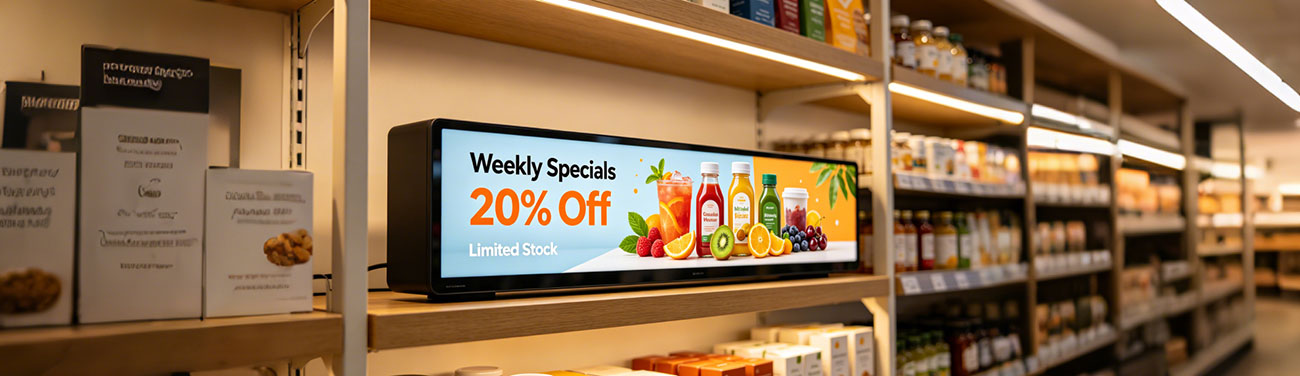
拉伸条显示器是一种液晶显示器(LCD)面板,其设计具有超宽纵横比,通常在3:1至8:1或更高的范围内,而不是传统商用显示器上的16:9(宽屏)或4:3(标准)比例。物理形状因子被故意拉长和变窄,旨在与零售货架单元、吊舱边缘、冷冻门框或产品托盘轨道齐平或嵌入其中。
底层LCD技术与商用级平板显示器基本相同:TFT(薄膜晶体管)矩阵、背光组件、偏振层和滤色器。拉伸条形显示器的区别在于面板切割过程、活动显示区域的纵横比、补偿窄面板几何形状所需的亮度工程,以及在销售点将显示器嵌入零售家具所需的集成设计。
1.2常见物理格式
用于零售货架的拉伸条形显示器有各种标准化和定制的物理尺寸。最常用的外形尺寸包括:
• 23.1英寸(1920×360像素)——适用于标准90厘米货架宽度
• 28.6英寸(1920×360像素)——非常适合杂货店和大型超市环境中120厘米的隔间宽度
• 37.1英寸(1920×360像素)——经常部署在DIY零售、消费电子和仓库俱乐部格式中
• 10.1英寸(1280×390像素)-用于小型便利零售、药房货架条和酒店手推车显示器
• 根据OEM规格制造的定制纵横比和尺寸——这是HITULCD价值主张的核心能力
面板方向可以是横向(最常见的零售配置)或纵向(旋转90°),纵向经常用于端盖价格塔显示和垂直产品类别标识。
1.3条形显示器与传统显示器的区别
a和B之间的关键工程区别 拉伸条形面板 并且缩减的传统显示器不仅仅是几何形状的问题。生产功能性、长寿命的拉伸显示器需要在制造层面进行专门的面板工程,而不是对标准面板进行生产后的修改。明确地:
• 背光均匀性:标准背光设计用于方形或近方形宽高比。拉伸面板需要定制设计的边缘照明或直下照明背光阵列,在异常长、窄的有效区域内提供均匀的亮度。否则,显示器末端的亮度下降会产生不可接受的视觉不均匀性。
• 驱动板设计:时序控制器(TCON)和缩放器电子设备必须针对面板的原生分辨率和不寻常的像素矩阵进行专门设计。当与非标准面板几何形状配对时,通用驱动板会产生图像失真、色带和刷新伪影。
• 热管理:机框边缘显示器的窄机箱将背光组件的热量集中在一个紧凑的物理外壳中。如果没有专门设计的散热,包括散热器材料、机箱气流建模和背光驱动器校准,面板寿命将大大缩短。
• 机械集成:零售货架显示器必须从头开始设计,以便与吊舱硬件、磁性连接系统、卡入式货架轨道通道或嵌入式无边框安装进行安装集成。传统显示器没有这些安装规定。
2.零售货架数字标牌的应用
2.1销售点沟通挑战
The retail shelf edge is the single most commercially valuable piece of real estate in a physical store. It is the location where a consumer's purchase decision is made — frequently within three to seven seconds of visual engagement with a product bay. For decades, this space was occupied exclusively by paper shelf edge labels (SELs) carrying price, barcode, and a limited amount of product information.
The limitations of paper SELs are well understood by retail operations professionals: high labor cost of label reprinting and replacement, inability to communicate dynamic pricing or promotional content, no capacity for video or animation, no integration with inventory management or loyalty systems, and a static visual presence that cannot compete with the sensory richness of competitive digital advertising environments.
Stretched bar displays resolve all of these limitations within the physical constraints of an existing shelf infrastructure.
2.2 Primary Use Cases
Grocery & Supermarket
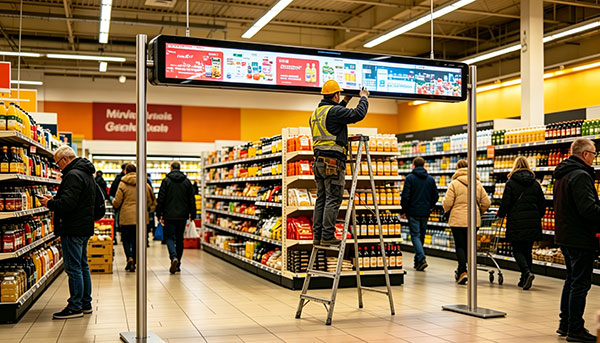
In grocery retail, stretched bar displays are deployed at the shelf edge beneath product facings. They display dynamic price information synchronized in real-time with the store's pricing management system, promotional messaging, nutritional highlights, country-of-origin data, and loyalty reward point multipliers. During promotional events, content can be updated instantaneously across all connected displays in a store or entire estate — a capability that paper labels cannot replicate.
Consumer Electronics & DIY
Large-format retail environments including consumer electronics chains and DIY home improvement stores deploy stretched bar displays on gondola uprights and shelf edge positions to communicate product comparison data, compatibility specifications, installation guides in video format, and bundle promotions. The longer 37-inch format is especially suited to these environments given the wider shelf bays characteristic of large-format retail.
Pharmacy & Health & Beauty
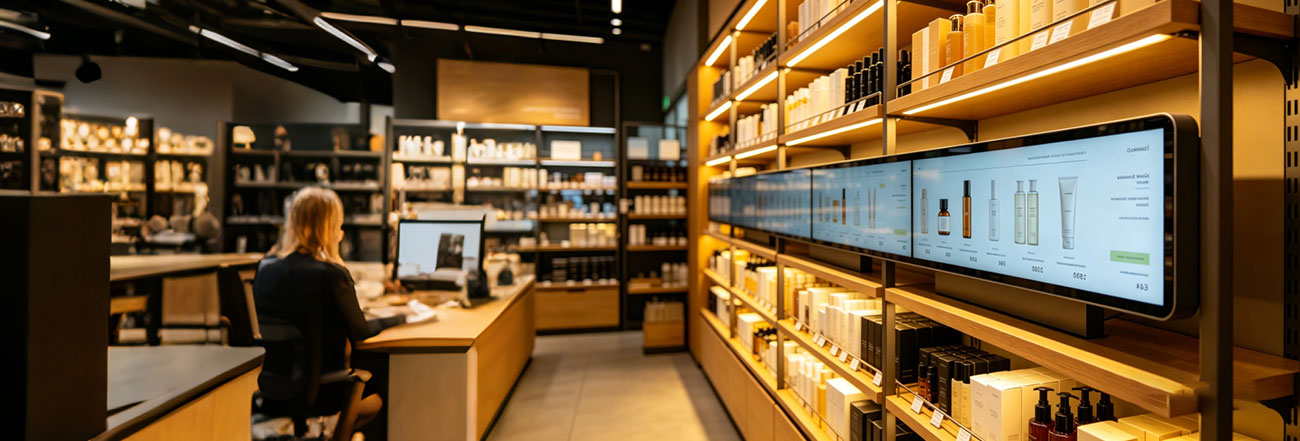
Pharmacy retailers use shelf-edge stretched displays to communicate regulated health claim information, dosage guidance, product differentiation messaging, and cross-sell recommendations. Integration with pharmacy dispensing systems enables real-time stock availability communication to both customers and store associates. The precision and accuracy of digital communication in this category has measurable compliance and liability implications.
Food Service & Hospitality
In food service environments, stretched bar displays are mounted on tray rails, buffet counters, beverage stations, and menu board strips. They communicate allergen information, caloric content, promotional pricing, and queue management messaging. Their resistance to humidity, temperature variation, and splash exposure — when appropriately specified — makes them viable in back-of-house and front-of-house food service settings.
Freezer & Chiller Aisle
The freezer aisle presents one of the most technically demanding environments in retail digital signage. Condensation, low ambient temperatures, and aggressive thermal cycling create conditions that cause generic LCD panels to fail prematurely through moisture ingress, backlight delamination, and adhesive failure. Proper stretched bar displays for this application require specific cold-start engineering, anti-condensation treatments, and sealed connector interfaces — engineering considerations that HITULCD addresses at the product design level.
3. Key Technical Specifications Explained
3.1 Brightness and Ambient Light Rejection
Retail environments present significant ambient light challenges. Fluorescent tube lighting, LED track lighting, and large skylights in big-box retail environments can produce ambient illuminance levels at the shelf face of 500 to 2,000 lux or above. A display operating at 250 nits — the typical brightness of an office monitor — will appear washed out, lacking contrast, and functionally invisible in these conditions.
HITULCD stretched bar displays are specified at a minimum 700 nits for standard retail applications, with high-brightness variants rated to 1,500 nits for environments with extreme overhead lighting. This brightness specification is maintained across the full operating temperature range of the display, not merely at cold start — a distinction that is frequently obscured in competitor specification sheets.
3.2 Resolution and Pixel Density
The standard resolution for a 23.1-inch shelf-edge stretched display is 1920 × 360 pixels, yielding a pixel density in the horizontal axis comparable to full HD content and sufficient for legible text at standard retail viewing distances of 0.3 to 1.5 meters. At longer shelf widths, maintaining pixel density across a 37-inch or 49-inch panel requires a minimum horizontal resolution of 1920 pixels to preserve text legibility for pricing and promotional copy.
HITULCD engineers the pixel pitch of each panel variant to maintain content legibility at the intended minimum viewing distance, and provides content specification templates to integration partners and end users that prevent common errors such as incorrect font sizing, inadequate contrast ratios, or image compression artifacts.
3.3 Connectivity and Content Management
Modern stretched bar displays for retail deployment must integrate seamlessly into the broader store technology ecosystem. HITULCD displays support multiple connectivity architectures:
• Built-in Android OS (Android 11 and above): Eliminates the need for an external media player. Content management is handled via a compatible CMS (content management system) delivered over the store's Wi-Fi or LAN infrastructure. This architecture significantly reduces hardware cost and installation complexity at scale.
• HDMI / DVI input: For integration with central media player infrastructure where a single player drives multiple displays via a distribution amplifier or daisy-chain topology.
• RS-232 and LAN control: For integration with building management systems, POS systems, or store operations platforms that require programmatic control of display power state, brightness, and input selection.
• USB media playback: For store environments without centralized CMS infrastructure, enabling scheduled content playback from removable media with no network dependency.
3.4 Operating Lifespan and Reliability
Retail digital signage is a continuous-operation application. Displays in grocery and convenience retail frequently operate 16 to 24 hours per day, seven days per week. At these operating hours, a display rated for 30,000 hours of backlight life — common in consumer and low-grade commercial panels — will require backlight replacement or full panel replacement within three to four years of deployment.
HITULCD stretched bar displays are rated at 50,000+ hours of backlight life under continuous operation conditions, representing a deployed operational lifespan of six to eight years at typical retail duty cycles. This specification has direct implications for total cost of ownership (TCO) calculations and is a primary driver of HITULCD's commercial value proposition to enterprise retail operators.
4. HITULCD Stretched Bar Displays vs. The Market
The following comparison reflects independently verifiable specifications and engineering differentiators as of 2025. HITULCD's engineering team welcomes direct technical comparison with any competitor product on a specification-by-specification basis.
Feature | HITULCD Stretched | Standard LCD | Competitor Strips |
宽高比 | 3:1 ~ 8:1 custom | 16:9 only | Fixed 3:1 |
Brightness (nits) | 700 – 1,500 | 250 – 400 | 350 – 500 |
Operating Temp | -20 °C to +60 °C | 0 °C to +40 °C | 0 °C to +45 °C |
Lifespan | 50,000 hrs+ | 30,000 hrs | 40,000 hrs |
Custom Size | ✓ Yes | ✗ No | Limited |
Android/Win OS | ✓ Built-in | ✗ External only | ✗ External only |
IP Rating | IP54 optional | IP40 | IP42 |
保修 | 3 Years | 1 Year | 1 Year |
4.1 What Makes HITULCD Different
The display industry is not short of manufacturers capable of producing a stretched bar panel to a standard specification sheet. What distinguishes HITULCD is the depth of engineering investment applied at each stage of product development, and the manufacturing discipline that translates engineering intent into consistent, field-proven product performance.
Purpose-Built Panel Engineering, Not Commodity Repurposing
A significant proportion of stretched bar displays available in the market are produced by purchasing standard LCD panels from commodity suppliers and mechanically trimming them to a narrower form factor. This approach is cost-effective at the manufacturing level but introduces fundamental reliability problems: the backlight assembly, which was engineered for the original full-width panel, is now operating outside its design envelope, producing uneven illumination, accelerated LED degradation, and thermal stress concentrations.
HITULCD sources or co-develops panel substrates that are manufactured to the target aspect ratio from the substrate cutting stage. The backlight assembly, TCON design, and chassis thermal architecture are all specified and validated for the specific panel geometry — not adapted from a standard panel design. This distinction is visible in measured brightness uniformity data, which HITULCD provides to qualified OEM customers on request.
Thermal Engineering for Continuous Retail Operation
The narrow chassis of a shelf-edge display concentrates backlight thermal output in a tightly constrained physical volume. Without active thermal management, this produces localized hotspots that accelerate LCD panel degradation, induce color shift, and reduce backlight lifespan. HITULCD's mechanical engineering team conducts computational fluid dynamics (CFD) modeling of chassis thermal behavior for each display model, validating designs through accelerated life testing at elevated temperature conditions before production release.
Cold-Chain and Freezer-Aisle Certification
HITULCD is one of a small number of manufacturers that has specifically engineered and certified 拉伸条显示 products for deployment in freezer aisle and cold-chain environments. Key features of HITULCD's cold-environment variants include cold-start backlight management (ensuring full brightness is achieved within 30 seconds at -20°C), anti-condensation heating elements on the display face glass, IP54-rated sealed connector interfaces, and chassis materials selected for thermal expansion compatibility across the full -20°C to +60°C operating range.
Custom OEM Program
HITULCD operates a structured custom OEM program that allows retail technology integrators and retail operators to specify display form factors, bezel dimensions, mounting interface types, embedded computing configurations, and branding requirements outside the standard product catalog. Minimum order quantities for custom variants are negotiated on a project basis, with engineering support provided from initial requirements through production validation. This program has supported deployments across grocery, pharmacy, luxury retail, and food service verticals in North America, Europe, and Asia-Pacific.
Software Ecosystem Integration
HITULCD displays are validated for compatibility with the leading retail digital signage content management platforms including Scala, Signagelive, Yodeck, and Rise Vision, as well as major enterprise retail operating platforms. HITULCD's technical team maintains integration documentation and provides pre-sales technical support to assist system integrators in designing compatible content management architectures before equipment procurement.
5. Deployment Planning: What Retail Operators Need to Know
5.1 Infrastructure Requirements
Successful stretched bar display deployment requires planning across four infrastructure dimensions:
• Power distribution: Each display draw between 8W and 25W depending on size and brightness specification. A typical 4-bay gondola section with one display per shelf level across six shelf levels requires provision for approximately 150W of continuous power draw, plus appropriate circuit protection and cable management within the gondola infrastructure.
• Network connectivity: Wi-Fi or wired LAN connectivity must be provided at the display location for CMS-driven content update. Store Wi-Fi infrastructure should be assessed for signal coverage at shelf level before deployment planning is completed — signal attenuation from metal gondola uprights is a common source of connectivity issues in pilot deployments.
• Content management system: A CMS with native support for stretched display resolutions and aspect ratios is essential. Standard 16:9 CMS templates require adaptation for 3:1 or greater aspect ratios. HITULCD provides resolution-specific template packs and content specification guidelines to customers.
• Mounting and installation hardware: HITULCD supplies gondola-specific mounting hardware for the major shelf system standards used in UK, European, and North American retail environments, including standard 60mm and 50mm pitch rail systems.
5.2 Total Cost of Ownership Modeling
The business case for shelf-edge digital signage investment is most accurately evaluated on a total cost of ownership basis over a five-to-seven-year operational horizon. Key TCO components include:
• Hardware acquisition cost: Display unit cost including mounting hardware and any required media players
• Installation labor: Per-bay installation time, electrical work, and network provisioning
• CMS licensing: Per-display or per-site software licensing for content management platform
• Maintenance and replacement: Expected panel replacement rate over the operational horizon, based on published MTBF data and field failure rates
• Content production: Ongoing cost of producing and scheduling digital content
When evaluated on this basis, HITULCD's higher unit cost relative to commodity alternatives is consistently offset within 24 to 36 months by lower failure rates, reduced maintenance labor, and extended hardware lifespan — a calculation that HITULCD's commercial team can model in detail for qualified project opportunities.
6. Frequently Asked Questions
Can stretched bar displays be used outdoors or in semi-outdoor environments?
HITULCD produces high-brightness stretched bar display variants suitable for covered outdoor and semi-outdoor environments such as forecourt canopies, covered market halls, and enclosed shopping centre atriums. These variants are specified at 1,500 nits minimum brightness and feature IP54-rated enclosures. Fully exposed outdoor applications require a different product category (outdoor-rated displays with active temperature management) and should be discussed with HITULCD's technical sales team.
What is the minimum order quantity for custom-size panels?
Minimum order quantities for custom OEM panel sizes vary based on the degree of customization required. Standard catalog modifications (bezel color, custom branding, OS configuration) can be accommodated at quantities from 50 units. Full custom panel geometry requires a more significant minimum commitment and involves an NRE (non-recurring engineering) cost for tooling and validation. HITULCD's OEM team will provide a detailed project assessment upon receipt of a requirements brief.
How are content updates managed across a large estate of displays?
For large multi-site estates, HITULCD recommends deployment of a cloud-hosted CMS platform with device management capability. Content updates can be scheduled centrally and distributed to displays via the store network, with individual display or display group targeting capability. HITULCD's displays support remote monitoring of operational status, enabling proactive identification of connectivity or hardware issues before they impact the customer experience.
What warranty and after-sales support does HITULCD provide?
HITULCD stretched bar displays carry a standard three-year manufacturer's warranty covering defects in materials and workmanship under normal operating conditions. Extended warranty terms of up to five years are available by arrangement for enterprise-scale programs. HITULCD provides technical support via a dedicated commercial support desk staffed by engineers with direct knowledge of the product range — not third-party service desk operations.
Conclusion: The Strategic Case for Stretched Bar Displays in Retail
The stretched bar display is not a peripheral product category in retail digital signage — it is the enabling technology for the next generation of shelf-edge communication, price management, and shopper engagement in physical retail. The retailers and retail technology providers that deploy well-engineered, long-life stretched bar displays now are building a digital communication infrastructure that will define their competitive positioning across the remainder of this decade.
HITULCD's position in this market is founded on engineering depth, manufacturing discipline, and a proven track record of supporting enterprise retail programs from initial pilot through multi-market rollout. We manufacture to a higher standard because our customers operate in environments where display failure has direct commercial consequences — and we stand behind our products with the warranty terms, support infrastructure, and technical expertise to demonstrate that commitment.
To discuss your retail shelf display program — whether at the pilot planning stage, specification development, or full commercial rollout — contact HITULCD's commercial team. We provide pre-sales technical consultation, reference site visits where applicable, and detailed commercial proposals tailored to your program requirements.
HITULCD — Professional Stretched Bar Display Solutions
www.hitulcd.com | chenhua@hitulcd.com | Technical Support: chenhua@hitulcd.com
© 2025 HITULCD. All technical specifications subject to change without notice. All rights reserved.