HITULCD
显示技术部
技术应用白皮书
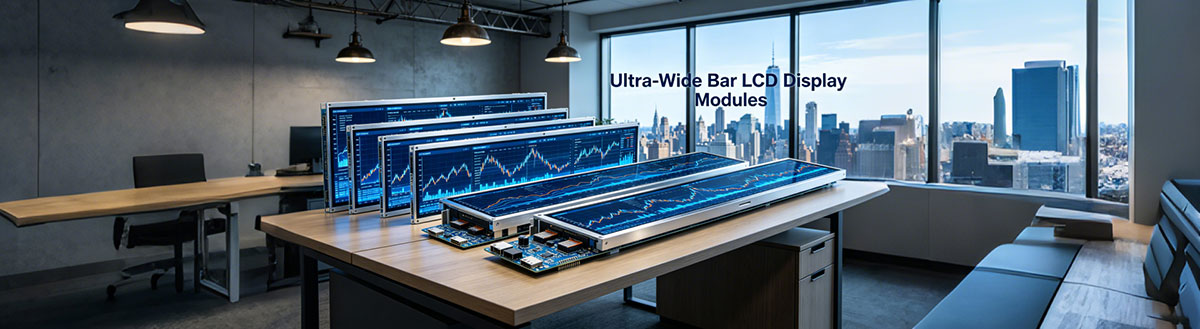
超宽条形液晶显示模块
工业和商业部署的工程、集成和现场应用指南
文档版本 2.4 (2025) | 分类 B2B机密 | 签发机构 HITULCD工程部。 |
1.执行摘要
本文档为HITULCD超宽条形LCD显示模块提供了全面的技术参考,该产品系列是专门为解决标准格式显示器在空间受限、高环境光和连续工作商业环境中的局限性而开发的。
HITULCD自2009年以来一直在制造液晶面板模块。这 超宽条形显示器 这条线——这里定义为纵横比从3:1到16:1甚至更高的面板——是为了满足交通基础设施运营商、零售货架边缘集成商和工业自动化工程师的直接需求而引入的,他们需要的显示器无法从主流消费级供应链中获得。
与源自电视或显示器生产线的传统矩形面板不同,HITULCD条形显示器是在电池切割阶段设计的。每个模块的尺寸、背光架构和接口配置都是预期应用程序的原生配置,而不是现成的组件。这种区别对亮度均匀性、热稳定性和长期可靠性具有重大影响,本文将详细介绍所有这些。
目标读者群是在北美和欧洲从事项目的硬件工程师、采购经理和系统集成商。内容假定熟悉LCD模块数据表、信号时序规范和标准工业集成实践。
2.产品定义:什么是条形液晶显示器?
术语";“条形显示”;或";“拉伸显示”;在整个行业中使用不一致。就本文件而言,HITULCD将条形LCD模块定义为纵横比等于或大于3:1的任何有源矩阵TFT面板,以标准宽高比配置生产,其中短尺寸通常在50mm至250mm之间。
2.1宽高比范围
HITULCD目前的生产目录涵盖了以下纵横比系列:
3:1酒吧 | 例如23.1”;(1920×640)——货架边缘、POS、售货亭标题 |
4:1巴 | 例如28.6英寸;(1920×480)——公交显示屏,公交车内部 |
5.3:1巴 | 例如37.1〃;(1920×360)——体育场外墙、零售通道 |
7:1酒吧 | 例如19英寸;(1920×272)——工业机架人机界面,服务器状态 |
16:1酒吧 | 例如14.9英寸;(1280×80)——电梯楼层指示器、货架标签 |
自定义比率 | Up to 32:1 available via custom cell-cut program |
2.2 How HITULCD Bar Panels Are Cut
Standard LCD glass substrates are produced in Generation 8.5 or Generation 10.5 size sheets (approximately 2200×2500 mm and 2940×3370 mm respectively). Consumer TV and monitor panels are cut from these sheets using fixed patterns optimized for 16:9 or 16:10 geometries.
HITULCD works directly with panel cell suppliers to arrange custom substrate cut plans. For bar displays, this means requesting non-standard cut patterns — sometimes referred to in manufacturing as "odd-cut" or "salvage-utilization" cuts — that allocate substrate area to wide, short rectangles. The engineering consequence is that the TFT array, the color filter layout, and the polarizer alignment are all configured natively for the bar geometry from the point of glass deposition.
This is fundamentally different from the approach taken by some competitors, who take standard 16:9 panels and mask or crop the active area. Masked panels retain the original backlight architecture designed for the full panel size, leading to uneven luminance distribution in the active zone. HITULCD bar panels have backlights sized and diffused for the actual active area.
3. Technical Architecture
3.1 Backlight Engineering for Bar Format
Backlight uniformity is the single most common failure mode in third-party bar display conversions, and it is the area where HITULCD invests the most differentiated engineering effort.
For panels with aspect ratios below 6:1, HITULCD uses edge-lit LED arrays with a custom light guide plate (LGP) designed around the specific short-dimension measurement. The LGP diffusion pattern — etched or printed onto the acrylic substrate — is calculated to compensate for the high aspect ratio, ensuring that luminance variation across the panel width does not exceed ±8% under standard temperature conditions. For context, many repurposed bar displays sourced from panel salvage operations exhibit uniformity variations of ±20% to ±30% or worse.
For panels with aspect ratios above 6:1 and short dimensions below 100 mm, HITULCD uses direct-lit mini-LED arrays in select SKUs, enabling local dimming across the bar width. This allows the display to maintain contrast performance in scenarios where only a portion of the bar is actively rendering content — common in shelf-edge price display and train departure board applications.
3.2 Thermal Management
Bar displays are disproportionately affected by thermal gradient problems because the high aspect ratio creates a situation where one end of the panel may be significantly closer to a heat source (power supply, processor board, or enclosure wall) than the other end.
HITULCD addresses this through two mechanisms:
• Thermal spreading layer: A graphite thermal interface sheet is integrated between the backlight chassis and the rear metal frame on all panels above 20 inches in total diagonal. This distributes localized heat from LED clusters across the full panel length, measured to reduce peak-to-trough temperature differential by 6°C to 11°C depending on enclosure conditions.
• Operating range validation: All HITULCD bar modules are aged at 60°C for a minimum of 96 hours before shipment. Storage temperature compliance (typically -20°C to +60°C) and operating temperature compliance (0°C to +50°C standard, or -30°C to +70°C for extended-temperature SKUs) are verified at the batch level, not sampled.
3.3 Signal Interface Options
HITULCD bar modules are available with the following interface configurations, depending on panel resolution and size:
LVDS (single/dual) | Standard for panels up to 1920×540; single-channel for lower resolutions |
eDP 1.3 / 1.4 | Preferred for 1920×720 and above; supports higher bandwidth without signal loss |
MIPI DSI | Available for panels below 10" diagonal; suited for embedded SoC integration |
HDMI 1.4 (via timing controller) | Available as integrated solution with HITULCD TCON board |
Custom TCON board | HITULCD offers proprietary TCON design for custom timing requirements |
A key practical point for integrators: because bar resolutions are non-standard, many off-the-shelf media players and embedded computers do not include native support for bar timing in their firmware. HITULCD provides a timing configuration guide for each panel model, covering both Linux (kernel modeline parameters) and Windows (custom INF/EDID injection). This is included in the standard integration package at no additional cost.
3.4 Touch Integration
Capacitive touch overlays for bar formats present a design challenge that flat-panel touch vendors rarely address adequately. Standard projected-capacitive (PCAP) sensors are designed for rectangular formats, and the ITO routing patterns used for high-aspect-ratio sensors must be custom-designed to maintain sensor uniformity across the full touch length.
HITULCD offers factory-bonded PCAP overlays for select bar models, using sensor films designed in-house with optimized electrode pitch for the bar geometry. The bonding process uses optical clear adhesive (OCA) applied under vacuum conditions, achieving bubble-free adhesion with haze values below 1%. Touch controller firmware is pre-calibrated for bar-format linearity before delivery.
Integrators who require touch should specify this at the initial inquiry stage, as the OCA bonding process requires a separate production run and adds approximately 12-15 business days to lead time.
4. Application Engineering by Vertical
4.1 Retail and Point-of-Sale
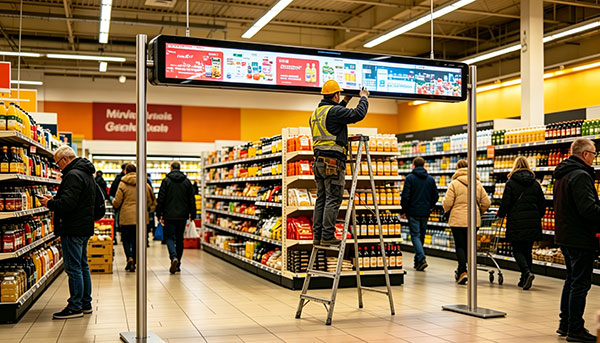
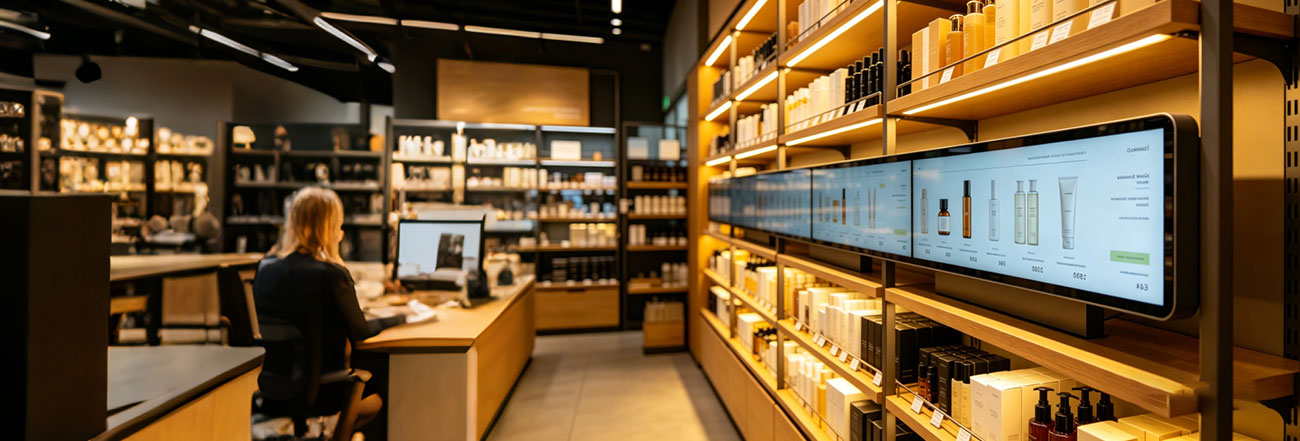
Shelf-edge and POS header displays represent the highest-volume deployment category for HITULCD bar modules in European and North American markets. The demands of this vertical drove several specific product decisions:
• Brightness floor at 700 cd/m²: Supermarket and pharmacy retail environments routinely have ambient illuminance exceeding 1000 lux at shelf height. Consumer monitors operating at 250-350 cd/m² wash out entirely. HITULCD shelf-edge models start at 700 cd/m² and scale to 1200 cd/m² for freezer aisle installations where high-reflectance door surfaces create additional glare.
• Always-on duty cycle: Retail displays are typically powered 14-18 hours per day, 365 days per year. HITULCD LED backlights are rated to maintain >70% initial luminance (L70) for a minimum of 50,000 hours of operation at 25°C. This equates to approximately 8-9 years of continuous retail operation before the display falls below perceptibility thresholds for price text rendering.
• EMC compliance: HITULCD bar modules destined for European retail applications are tested and documented for CE marking under EN 55032 (emissions) and EN 55035 (immunity). FCC Part 15 Class B documentation is provided for US market deployments. Customers receive the full compliance test report as part of the shipment package.
4.2 Transportation and Transit Infrastructure
Bus, metro, and rail interior displays operate in some of the most demanding environments that a display module can face: continuous vibration, wide temperature swings from vehicle exterior to cabin interior, condensation events, and the requirement for uninterrupted operation across multi-year service cycles.
HITULCD transportation-grade bar modules incorporate the following design features in response to this operating environment:
• Vibration and shock testing: IEC 60068-2-6 (sinusoidal vibration) and IEC 60068-2-27 (mechanical shock) compliance is verified at the panel assembly level. Typical automotive and rail vibration profiles (5-500 Hz, 2G peak) do not cause pixel anomalies, backlight failures, or connector disengagement in HITULCD transportation SKUs.
• Wide temperature operation: Standard panel specifications target 0°C to +50°C operating range. HITULCD's extended-temperature transportation variants operate from -30°C to +70°C, achieved through modified liquid crystal mixtures with wider nematic phase ranges and backlight thermal management tuned for cold-start performance. Cold-start time to full luminance at -20°C is under 90 seconds.
• Anti-condensation coating: Interior transit displays in buses and trams are exposed to rapid humidity changes when doors open. HITULCD offers an optional hydrophobic anti-condensation coating on front glass for modules destined for this application. The coating reduces surface water adhesion and prevents the fogging artifacts that degrade legibility during passenger boarding events.
4.3 Industrial HMI and Machine Interface
Industrial customers represent a smaller volume but higher specification complexity segment of HITULCD's bar display business. HMI panel integrators in Germany, Scandinavia, and the US Midwest have driven requirements that include:
• Long-term supply commitment: Industrial machine lifecycles can extend 10-15 years. HITULCD maintains a supply commitment program under which bar models can be reserved against a minimum volume agreement for up to 7 years of product continuity. This addresses the obsolescence risk that is endemic to sourcing display components from consumer supply chains.
• Panel-level burn-in resistance: Machine interfaces often display static elements (axis labels, alarm indicators, unit callouts) for extended periods. HITULCD applies a proprietary pixel dithering algorithm at the TCON level for static content patterns, measurably extending the time before differential aging creates visible retention artifacts.
• IP-rated enclosure compatibility: HITULCD provides front-panel sealing frame kits for IP54 and IP65 mounting configurations for select bar models. The frame kits include pre-cut foam gasket material dimensioned for the specific panel model and are designed to be integrated directly into customer enclosure designs using the mounting dimensions documented in the product datasheet.
4.4 Hospitality and Digital Signage
Hotel corridor information panels, elevator floor displays, and restaurant menu header boards represent growing deployment categories for bar LCD in North America and the UK. The primary requirements in this vertical are aesthetic — thin profile, minimal bezel, low-noise operation — combined with network connectivity for content management.
HITULCD supplies bar modules for these applications in both open-frame (integration-ready) and enclosed (finished product) configurations. The enclosed units include an integrated Android-based media player with Wi-Fi and Ethernet connectivity, HDMI input as a secondary source, and a management API compatible with standard digital signage software platforms including BrightSign, ScreenCloud, and Scala. Custom firmware builds are available for large-volume customers who require integration with proprietary CMS infrastructure.
5. HITULCD vs. Standard Market Alternatives
The following comparison is based on documented engineering characteristics of HITULCD bar modules versus the three most common alternative approaches: repurposed consumer panels, imported commodity bar modules, and custom-cut TV cell salvage panels.
Parameter | HITULCD Bar Module | Consumer / Generic Commodity Bar | Integration Advantage |
Backlight Uniformity | ±8% max (native cut) | ±20–30% typical (adapted) | Eliminates hot-spot artifacts in imaging apps |
Brightness (typical) | 700–1200 cd/m² | 300–500 cd/m² | Readable in >1000 lux retail/transit ambient |
Operating Temp. | 0 to +50°C std.; -30 to +70°C ext. | 0 to +40°C typical | Compliant for transport, outdoor kiosk |
L70 Backlight Life | 50,000 hrs @ 25°C | 20,000–30,000 hrs typical | Reduces maintenance cycles by 40–60% |
Vibration Rating | IEC 60068-2-6 verified | Not typically tested | Required for rail / automotive homologation |
Interface Support | LVDS / eDP / MIPI / HDMI | LVDS only (most) | Reduces external board count |
Touch Option | OCA-bonded PCAP, factory cal. | Aftermarket, no cal. | Zero parallax, pre-calibrated linearity |
Timing Config Support | Full guide + EDID provided | None or generic | Reduces integration time significantly |
CE / FCC Documentation | Full test report included | Declaration of conformity only | Simplifies product certification |
Supply Continuity | Up to 7-year program | Not offered | Eliminates mid-lifecycle redesign risk |
6. Production Quality and Inspection Process
HITULCD operates a dedicated quality control process for bar format modules that differs from standard panel inspection in several respects. The non-standard geometry of bar panels means that conventional automated optical inspection (AOI) systems require custom fixture calibration for each panel model. HITULCD maintains a library of inspection fixtures for all current catalog models, and new models undergo fixture qualification before production release.
6.1 Defect Classification
HITULCD applies the following pixel defect classification thresholds, which are more stringent than the ISO 13406-2 / ISO 9241-307 Class II standard used by most consumer panel suppliers:
Bright Pixel Defect (Type 1) | Maximum 0 in active area for industrial/transport SKUs; ≤1 for commercial SKUs |
Dark Pixel Defect (Type 2) | Maximum 0 in central zone; ≤1 outside 10mm border for commercial SKUs |
Cluster Defect | 0 permitted in any zone regardless of SKU |
Line Defect | 0 permitted; any single-column or single-row failure is a reject |
Luminance Uniformity | Measured at 13-point grid; maximum deviation ±8% from center value |
Chromaticity Uniformity | Delta u'v' < 0.010 at white point across all measurement zones |
6.2 Burn-In Test Protocol
Every production batch of HITULCD bar modules undergoes a 96-hour powered aging test at 60°C with full white (100% duty cycle) backlight. This process is referred to internally as High Temperature Operating Life (HTOL) screening. Modules are then measured for luminance and chromaticity post-aging. Any module showing luminance degradation greater than 5% relative to pre-aging baseline is rejected.
This aging process serves two purposes: it screens for early-life failures caused by LED solder joint weaknesses or cell defects that are latent under standard test conditions, and it stabilizes the liquid crystal alignment layer so that the panel delivered to the customer is operating on the flat portion of its degradation curve rather than the steeper early-wear segment.
7. Custom Engineering Program
HITULCD maintains an active custom development program for OEM customers who require bar display specifications that fall outside the standard catalog. Common custom requests include:
• Non-catalog aspect ratios: Any aspect ratio from 2.5:1 to 32:1 is achievable subject to minimum order quantity (MOQ) discussion and substrate cut plan feasibility assessment. HITULCD's engineering team can produce a preliminary cut efficiency analysis and cost estimate within 5 business days of receiving a formal specification request.
• Custom luminance targets: Standard catalog models are factory-calibrated to specific luminance targets. Customers requiring alternative brightness levels — for example, lower brightness for surgical suite ambient lighting or higher brightness for outdoor-facing kiosk applications — can request luminance recalibration as a factory option.
• Custom interface boards: HITULCD designs and supplies application-specific interface boards (signal converters, power supply modules, controller boards) matched to specific bar panel models. Customers receive schematics, BOM, and Gerber files for these boards, enabling in-house manufacturing for high-volume programs.
• Optical bonding: For deployments requiring zero-parallax performance in high-ambient-light conditions, HITULCD offers optically bonded assemblies combining the LCD module with a customer-specified cover glass. The bonding process eliminates the air gap between cover glass and panel face, eliminating the internal reflection that degrades contrast under strong ambient illumination.
8. Supply Chain, Packaging, and Logistics
HITULCD ships bar display modules in custom-designed dual-wall corrugated packaging with vacuum-formed EVA foam inserts. Each module is individually sealed in an antistatic PE bag before insertion into the foam cavity. Cartons are labeled with a machine-readable QR code linked to the batch record in HITULCD's quality management system, enabling traceability to the production lot and inspection timestamp for each individual unit.
Standard incoterms offered are EXW (factory), FOB Shenzhen, and DAP (destination airport) for European and North American customers. Air freight and sea freight transit times and recommended packaging quantities per pallet are documented in the logistics annex provided to registered accounts.
HITULCD maintains a safety stock of standard catalog models at its Shenzhen facility. In-stock items ship within 3-5 business days of order confirmation. Custom production runs have standard lead times of 45-60 days from purchase order receipt and deposit confirmation, depending on substrate allocation scheduling.
9. Regulatory and Compliance Documentation
HITULCD provides the following compliance documentation as standard for all bar display modules shipped to North American and European customers:
CE Marking | LVD (EN 62368-1), EMC Directive (EN 55032 / EN 55035), RoHS Directive 2011/65/EU |
联邦通信委员会 | Part 15 Class B (USA); ICES-003 (Canada) |
RoHS符合性 | Full material declaration; no restricted substances above threshold limits |
REACH | SVHC substance screening performed; declaration provided on request |
IEC Standards | IEC 60068 series (environmental); IEC 62471 (optical/LED photobiological safety) |
WEEE | EU WEEE registration documentation provided for EU importers |
Customers requiring additional country-specific certifications (e.g., UKCA post-Brexit UK market, KC Mark for Korean market, BIS for India) should discuss this at the inquiry stage. HITULCD has existing test house relationships and can coordinate certification testing as part of the product development process for volume programs.
10. Technical Contact and Sample Program
HITULCD offers a sample program for qualified B2B customers evaluating bar display modules for integration projects. Sample units are available for catalog models at a sample price with a credit arrangement for customers who proceed to production purchase orders above specified thresholds.
Technical inquiries, including specification reviews, application feasibility questions, and custom development discussions, are handled by HITULCD's application engineering team. Response time for written technical inquiries is within 1 business day for European time zones and 1 business day for North American time zones.
Company | HITULCD Display Technology |
Product Focus | Industrial & Commercial LCD Modules — Bar / Stretch Display Specialist |
Engineering Inquiry | chenyun@hitulcd.com |
Sales & Sampling | chenhua@hitulcd.com |
Website | www.hitulcd.com |
Headquarters | Shenzhen, Guangdong, China |
EU Representative | Available on request for CE documentation purposes |
Document Notice
All specifications in this document reflect current production capabilities and are subject to change without notice as engineering improvements are implemented. Customers should request the current product datasheet for any specific model before finalizing mechanical or electrical design. HITULCD reserves the right to make changes to materials, components, and manufacturing processes that do not affect form, fit, or function without prior notification.
Copyright 2025 HITULCD Display Technology. Distribution of this document is restricted to registered B2B customers and authorized distribution partners. Reproduction in whole or in part without written permission is prohibited.